'%3e%3cpath%20d='M12.4997%201.33325C10.39%201.33325%208.32772%201.95884%206.5736%203.13091C4.81947%204.30298%203.4523%205.96888%202.64496%207.91796C1.83763%209.86704%201.62639%2012.0118%202.03797%2014.0809C2.44955%2016.15%203.46545%2018.0506%204.95721%2019.5424C6.44897%2021.0342%208.34959%2022.0501%2010.4187%2022.4616C12.4878%2022.8732%2014.6326%2022.662%2016.5816%2021.8546C18.5307%2021.0473%2020.1966%2019.6801%2021.3687%2017.926C22.5408%2016.1719%2023.1663%2014.1096%2023.1663%2011.9999C23.1663%209.17094%2022.0425%206.45783%2020.0422%204.45745C18.0418%202.45706%2015.3287%201.33325%2012.4997%201.33325ZM12.4997%2021.3333C10.6537%2021.3333%208.84922%2020.7859%207.31436%2019.7603C5.7795%2018.7347%204.58322%2017.2771%203.8768%2015.5716C3.17039%2013.8662%202.98555%2011.9896%203.34568%2010.1791C3.70581%208.36859%204.59473%206.70554%205.90002%205.40025C7.20531%204.09496%208.86835%203.20605%2010.6788%202.84592C12.4893%202.48579%2014.3659%202.67063%2016.0714%203.37704C17.7768%204.08346%2019.2345%205.27974%2020.2601%206.8146C21.2856%208.34945%2021.833%2010.154%2021.833%2011.9999C21.833%2014.4753%2020.8497%2016.8492%2019.0993%2018.5996C17.349%2020.3499%2014.975%2021.3333%2012.4997%2021.3333Z'%20fill='white'/%3e%3cpath%20d='M19.167%208.06667C19.042%207.9425%2018.8731%207.8728%2018.697%207.8728C18.5208%207.8728%2018.3519%207.9425%2018.227%208.06667L10.8269%2015.4333L6.82695%2011.4333C6.70495%2011.3016%206.53562%2011.2237%206.35621%2011.2169C6.1768%2011.21%206.00201%2011.2747%205.87028%2011.3967C5.73856%2011.5187%205.66069%2011.688%205.65382%2011.8674C5.64694%2012.0468%205.71162%2012.2216%205.83362%2012.3533L10.8269%2017.3333L19.167%209.01333C19.2294%208.95136%2019.279%208.87762%2019.3129%208.79638C19.3467%208.71514%2019.3642%208.62801%2019.3642%208.54C19.3642%208.45199%2019.3467%208.36485%2019.3129%208.28361C19.279%208.20237%2019.2294%208.12864%2019.167%208.06667Z'%20fill='white'/%3e%3c/g%3e%3cdefs%3e%3cclipPath%20id='clip0_2790_31187'%3e%3crect%20width='24'%20height='24'%20fill='white'%20transform='translate(0.5)'/%3e%3c/clipPath%3e%3c/defs%3e%3c/svg%3e)


At HackenProof, we believe that some of the most valuable security knowledge is created inside the hacker community itself. This belief is reflected in our ongoing series of guest articles, where security researchers from our community share practical insights, practical knowledge, and real-world lessons from their work in smart contract security, Web3 development, and bug bounty research. By publishing hacker-authored content, we aim to make expert-level security knowledge more accessible and to support continuous learning across the broader Web3 security ecosystem.
We regularly curate and publish the strongest technical articles based on their educational value, technical depth, and relevance to real security challenges. Authors whose work is published on the HackenProof blog receive the Star Author achievement, recognizing their contribution to knowledge sharing and community growth.
Read the article, explore the ideas, and share your thoughts with the community — and if you have expertise to share, this could be your first step toward becoming our next Star Author.
Background and Scope
This article was written by Hammad Iftikhar, a Protocol Risk Analyst specializing in ZK, L2, and DeFi, who has been a member of the HackenProof community since September 2024. Drawing on hands-on experience in protocol risk analysis, the author focuses on the fundamentals of Solidity that every smart contract developer needs to understand before moving into more advanced security topics.
We selected this guide for publication because it offers a clear, structured introduction to Solidity — from core language concepts and data types to functions, modifiers, events, and error handling — while consistently grounding theory in practical development and security considerations. For beginners, it provides a solid foundation for writing safer smart contracts; for more experienced developers, it serves as a concise refresher on best practices that directly impact code quality and security in production environments.
🖋 Editor’s note: This article was originally published by the author on LinkedIn and is shared here with permission as part of our community guest article series.
What Is Solidity?
Solidity is a statically typed, high-level programming language designed for developing smart contracts on the Ethereum blockchain. Its syntax is influenced by JavaScript and C++, making it relatively approachable for developers with prior programming experience.
Smart contracts written in Solidity are deployed to and executed on the Ethereum Virtual Machine (EVM). These contracts act as self-executing agreements, with logic and rules enforced directly by code rather than intermediaries.
Key Features of Solidity
Some of the core characteristics that define Solidity include:
- Statically typed languageVariable types must be explicitly declared, reducing ambiguity and certain classes of runtime errors.
- Contract-oriented designCode is organized into contracts that encapsulate both data and functions.
- Inheritance supportContracts can inherit from one another, enabling code reuse and modular design.
Essential Solidity Concepts
Variables and Data Types
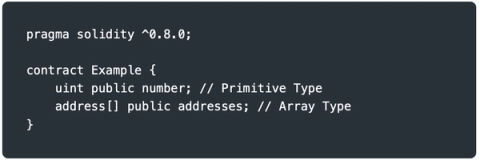
Solidity supports a wide range of data types, which can be broadly categorized into primitive and complex types.
- Primitive types include
uint,int,bool,address, andbytes. - Complex types include arrays, structs, and mappings.
Arrays may be fixed-size or dynamic, structs allow developers to define custom data structures, and mappings provide efficient key–value storage.
Example:
Functions
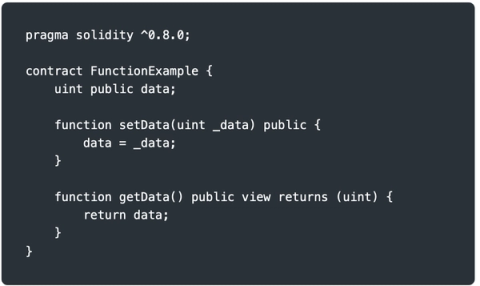
Functions define the executable logic of a smart contract. When working with functions in Solidity, several aspects are especially important:
- VisibilityFunctions can be declared as
public,external,internal, orprivate, determining who can call them. - State mutabilityModifiers such as
viewandpureindicate whether a function reads from or modifies the contract’s state.
Example:
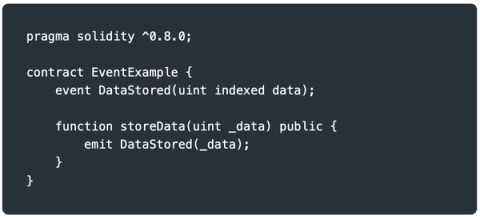
Events
Events enable smart contracts to communicate with external applications. They log data on the blockchain, which can be monitored by off-chain services such as user interfaces or analytics tools.
Example:
Modifiers
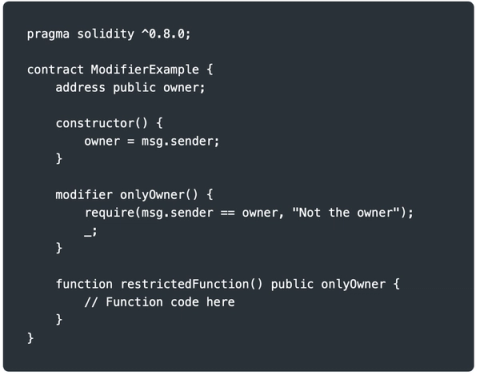
Modifiers allow developers to alter or constrain the behavior of functions. They are commonly used for access control, validation, and enforcing preconditions.
Example:
Error Handling
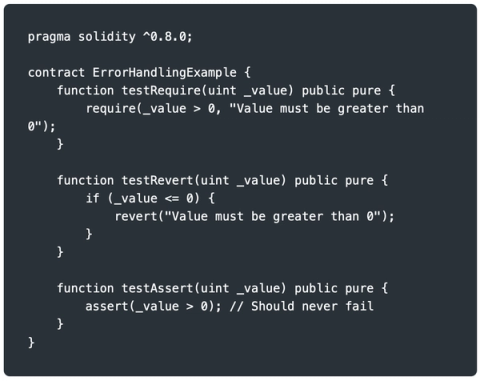
Solidity provides several mechanisms for handling errors and enforcing conditions:
requireUsed to validate inputs and conditions before execution continues.revertExplicitly aborts execution and reverts state changes with a custom error message.assertUsed for internal checks that should never fail under correct logic.
Example:
Practical Tips for Beginners
✔️ Start Small
Begin with simple contracts to build familiarity with Solidity syntax and behavior. Writing basic contracts, such as a “Hello World” or a minimal token, helps reinforce foundational concepts.
✔️ Use Development Tools
Development environments like Remix IDE are well-suited for learning and experimentation. For more advanced workflows, tools such as Foundry and Hardhat support local development, testing, and deployment.
✔️ Follow Best Practices
- Security awarenessBe mindful of common vulnerabilities such as reentrancy and arithmetic issues. Established libraries like OpenZeppelin help mitigate known risks.
- Gas efficiencyOptimize logic to reduce unnecessary computation and storage usage, which directly affects transaction costs.
✔️ Read and Review Existing Code
Studying open-source smart contracts and production codebases helps developers understand common patterns, trade-offs, and real-world constraints.
Conclusion
If you’re interested in applying these concepts in practice, HackenProof hosts multiple active bug bounty programs focused on Solidity-based projects. And if you represent a company building or maintaining smart contracts in Solidity, you can book a call with our team to discuss how to secure your protocol.