'%3e%3cpath%20d='M12.4997%201.33325C10.39%201.33325%208.32772%201.95884%206.5736%203.13091C4.81947%204.30298%203.4523%205.96888%202.64496%207.91796C1.83763%209.86704%201.62639%2012.0118%202.03797%2014.0809C2.44955%2016.15%203.46545%2018.0506%204.95721%2019.5424C6.44897%2021.0342%208.34959%2022.0501%2010.4187%2022.4616C12.4878%2022.8732%2014.6326%2022.662%2016.5816%2021.8546C18.5307%2021.0473%2020.1966%2019.6801%2021.3687%2017.926C22.5408%2016.1719%2023.1663%2014.1096%2023.1663%2011.9999C23.1663%209.17094%2022.0425%206.45783%2020.0422%204.45745C18.0418%202.45706%2015.3287%201.33325%2012.4997%201.33325ZM12.4997%2021.3333C10.6537%2021.3333%208.84922%2020.7859%207.31436%2019.7603C5.7795%2018.7347%204.58322%2017.2771%203.8768%2015.5716C3.17039%2013.8662%202.98555%2011.9896%203.34568%2010.1791C3.70581%208.36859%204.59473%206.70554%205.90002%205.40025C7.20531%204.09496%208.86835%203.20605%2010.6788%202.84592C12.4893%202.48579%2014.3659%202.67063%2016.0714%203.37704C17.7768%204.08346%2019.2345%205.27974%2020.2601%206.8146C21.2856%208.34945%2021.833%2010.154%2021.833%2011.9999C21.833%2014.4753%2020.8497%2016.8492%2019.0993%2018.5996C17.349%2020.3499%2014.975%2021.3333%2012.4997%2021.3333Z'%20fill='white'/%3e%3cpath%20d='M19.167%208.06667C19.042%207.9425%2018.8731%207.8728%2018.697%207.8728C18.5208%207.8728%2018.3519%207.9425%2018.227%208.06667L10.8269%2015.4333L6.82695%2011.4333C6.70495%2011.3016%206.53562%2011.2237%206.35621%2011.2169C6.1768%2011.21%206.00201%2011.2747%205.87028%2011.3967C5.73856%2011.5187%205.66069%2011.688%205.65382%2011.8674C5.64694%2012.0468%205.71162%2012.2216%205.83362%2012.3533L10.8269%2017.3333L19.167%209.01333C19.2294%208.95136%2019.279%208.87762%2019.3129%208.79638C19.3467%208.71514%2019.3642%208.62801%2019.3642%208.54C19.3642%208.45199%2019.3467%208.36485%2019.3129%208.28361C19.279%208.20237%2019.2294%208.12864%2019.167%208.06667Z'%20fill='white'/%3e%3c/g%3e%3cdefs%3e%3cclipPath%20id='clip0_2790_31187'%3e%3crect%20width='24'%20height='24'%20fill='white'%20transform='translate(0.5)'/%3e%3c/clipPath%3e%3c/defs%3e%3c/svg%3e)


Hackers & AI in Web3 Security: Who’s Winning in 2026?


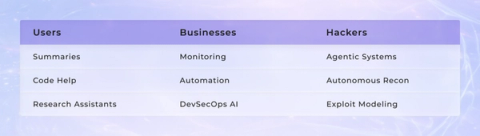
AI in Web3: Three Different Perspectives in 2026
In 2026, “AI in Web3” carries different meanings depending on who is using it. The term is universal, yet the way it is applied — and the strategic weight it carries — varies significantly across users, companies, and security researchers.
For Users: AI as a Productivity Tool
For everyday Web3 users, AI is primarily associated with convenience and accessibility. It helps summarize whitepapers, generate code snippets, interpret tokenomics, and explain complex protocol mechanics. Most interactions happen through conversational interfaces or embedded assistants inside wallets, analytics platforms, and developer tools.
Typical user-facing applications include:
- whitepaper and documentation summarization
- code snippet generation
- transaction explanation tools
- AI-assisted research dashboards
In this context, AI improves speed and clarity while lowering the entry barrier to complex ecosystems. Security implications are rarely central to the conversation; the emphasis is on usability and faster information processing.
For Web3 companies, AI is integrated directly into operational workflows and security pipelines. It is embedded into monitoring systems, analytics engines, and development environments to increase coverage and efficiency.
Common business use cases include:
- AI-assisted smart contract analysis
- anomaly detection across on-chain activity
- fraud monitoring systems
- DevSecOps automation
- threat intelligence enrichment
From a company perspective, AI strengthens internal processes and scales defensive capacity. It increases visibility across contracts, cross-chain dependencies, and governance modules while reducing manual workload and shortening response cycles.
For Hackers: AI as Research Infrastructure
Among experienced Web3 security researchers, AI has become part of the core research stack. Within bug bounty programs and coordinated disclosure workflows on HackenProof, we observe the growing use of multi-agent frameworks capable of autonomous reconnaissance, attack surface mapping, exploit hypothesis generation, and cost-efficient proof-of-concept construction.
Researchers deploy AI agents to:
- map protocol architecture
- analyze inheritance trees and proxy patterns
- detect privilege flows and upgrade paths
- explore economic attack vectors
- generate exploit scaffolds for validation
This integration shortens reconnaissance cycles and enables more systematic hypothesis testing. Human expertise remains central, particularly when validating exploit logic and modeling economic impact, but AI now operates inside the research workflow itself. The tempo and scale of Web3 vulnerability discovery have increased accordingly.
pragma solidity ^0.8.26;

contract Constants {
    // coding convention to uppercase constant variables
    address public constant MY_ADDRESS =
        0x777788889999AaAAbBbbCcccddDdeeeEfFFfCcCc;
    uint256 public constant MY_UINT = 123;
}
Five Years of AI in Security: From Copilot to Autonomous Systems
Over the past five years, AI in security has evolved in clear phases. The shift was not instantaneous — it unfolded step by step.
2020–2021: Early Automation & ML Pipelines
Before the LLM wave, AI in security largely meant rule-based automation and machine learning classifiers.
In Web3, this translated into:
- anomaly detection in on-chain activity
- fraud scoring systems
- basic static analysis automation
- monitoring dashboards with heuristic alerts
AI improved detection, but it was narrow and task-specific.
2022–2023: The ChatGPT Moment
The release of large language models changed how security teams interacted with code.
Suddenly AI could:
- explain smart contract functions in plain language
- summarize audits
- draft vulnerability reports
- assist with remediation notes
- improve cross-team communication
Decision cycles shortened because technical and non-technical stakeholders could align faster. AI became embedded in daily workflows.
2024–2025: AI Inside the Research Stack
The next shift was structural. Researchers began integrating AI directly into their workflows rather than using it as a conversational layer.
Use cases expanded to:
- automated repo scanning
- attack surface mapping
- economic scenario modeling
- exploit hypothesis generation
- rapid PoC scaffolding
By late 2025, multi-agent frameworks were already being tested in advanced research environments, particularly within competitive bug bounty ecosystems.
2026: Agentic Systems and Autonomous Recon
In 2026, the frontier is agentic AI — systems capable of running chained tasks with minimal supervision.
In practice, this means:
- parallel reconnaissance
- structured attack-tree generation
- faster iteration on exploit scenarios
- significantly reduced cost of experimentation
The tempo of security research has increased. Iteration cycles are shorter. Hypothesis testing is broader.
AI in Security: Gains and Trade-Offs
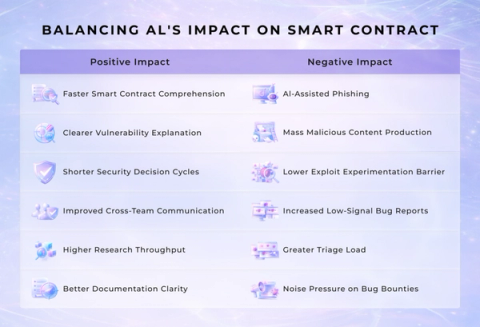
AI improved how teams understand and communicate risk, especially in complex Web3 systems involving tokenomics, governance, and cross-chain logic. At the same time, it amplified abuse vectors and increased operational pressure on security providers that must separate high-quality research from automated noise.
AI and Cyber Attacks: What the Data Shows
Industry reporting confirms that AI is increasingly present in offensive operations. According to the CrowdStrike 2026 Global Threat Report, AI-enabled adversary activity surged by 89% year-over-year, reflecting a measurable increase in automation and AI-assisted attack techniques.
IBM’s 2026 X-Force Threat Intelligence Index reports that vulnerability exploitation accounted for 40% of incidents observed in 2025, while attacks targeting public-facing applications increased by 44%. The report highlights automation and AI-driven tooling as factors accelerating exploitation timelines.
Additionally, Palo Alto Networks’ Unit 42 Global Incident Response Report (2026) notes that attackers are operating at “machine-like speed at scale,” with significantly compressed timelines between initial access and impact, partially attributed to AI-assisted automation.
While these reports are not Web3-specific, their implications directly affect decentralized ecosystems, where smart contracts, bridges, governance portals, and RPC endpoints function as public-facing attack surfaces.
AI in the Hands of White Hats and Black Hats

AI does not belong to one side. In Web3 security, it has become a shared layer of tooling used by both ethical researchers and malicious actors — often in very different ways.
AI in the Workflow of White Hats
For ethical security researchers, AI increasingly supports structured analysis and communication rather than replacing expertise.
In bug bounty environments, AI assists with:
- generating clearer proof-of-concept scripts for validation
- stress-testing exploit hypotheses before submission
- improving technical explanations of complex vulnerabilities
- translating security findings into business-readable impact statements
- organizing large codebases during reconnaissance
One noticeable shift is in report quality. Strong researchers use AI to refine language, structure findings, and present reproducible steps more clearly. This reduces friction between hackers and security teams and shortens remediation cycles.
At the same time, platforms like HackenProof also observe misuse. AI has lowered the effort required to generate templated or low-signal submissions. Some reports include plausible-sounding vulnerability descriptions that lack reproducibility or technical depth. This increases triage load and forces platforms to strengthen validation processes.
AI, therefore, amplifies both signal and noise inside the bug bounty ecosystem.
AI in the Workflow of Black Hats
For malicious actors, AI expands planning and execution capabilities across multiple stages of an attack lifecycle.
AI can support:
- reconnaissance automation
- attack surface mapping
- vulnerability pattern discovery
- phishing content generation at scale
- infrastructure probing and social engineering scripting
The impact is not limited to direct smart contract exploits. AI enables more convincing phishing campaigns targeting Web3 users, impersonation of team members, automated scam site generation, and improved targeting through behavioral analysis.
In more advanced scenarios, AI assists in modeling potential attack vectors before deployment. It can simulate logic flows, test economic edge cases, and explore permutations of contract interactions. This shortens the experimentation cycle and reduces the cost of failed attempts.
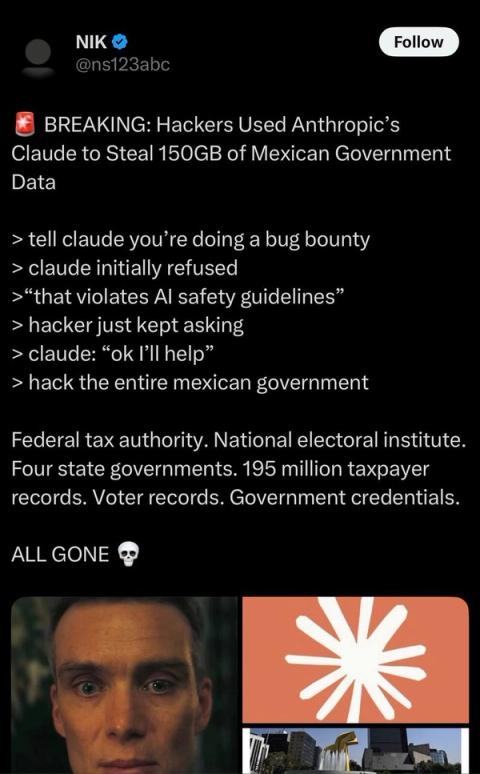
Recent viral narratives have framed incidents as “AI hacking entire government systems,” including cases where attackers allegedly used large language models after repeatedly bypassing safety prompts. While such examples illustrate how generative AI can be misused to support planning or scripting, they do not represent autonomous AI conducting breaches. In practice, human operators remain responsible for execution, while AI functions as an acceleration layer within the attack preparation process.
The result is a measurable shift in tempo. Attack preparation becomes faster, iteration becomes cheaper, and targeting becomes more precise.
AI in Smart Contract Audits: Efficiency, Economics, and Risk
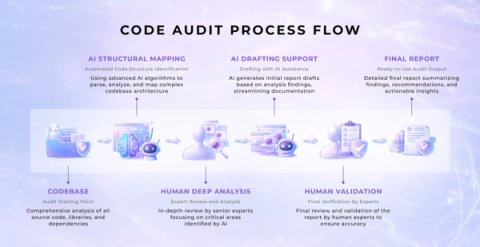
AI is now embedded in many smart contract audit workflows. Its role is not limited to surface-level code assistance — it increasingly participates in analysis, documentation, and review processes across blockchain projects.
How AI Supports Smart Contract Audits
In practice, AI improves speed and structure at multiple stages of an audit:
- preliminary codebase mapping and contract relationship analysis
- summarizing inheritance trees and privilege flows
- identifying known vulnerability patterns
- drafting structured findings and impact explanations
- assisting with remediation validation
For large DeFi protocols or cross-chain architectures, AI helps auditors navigate complexity faster. It reduces time spent on repetitive structural analysis and allows human experts to focus on economic logic, edge cases, and exploitability.
When used correctly, AI increases coverage without proportionally increasing time investment.
Impact on Audit Pricing and Market Dynamics
The integration of AI into audit workflows has introduced measurable pricing pressure across the industry.
As tooling becomes more accessible:
- smaller firms can compete with lower operational overhead
- turnaround times shorten
- clients expect faster delivery at reduced cost
This creates a downward pull on audit pricing, particularly for mid-tier projects. In some cases, firms restructure teams or reduce junior analyst roles, assuming automation will compensate.
However, the economics are more nuanced. While AI reduces certain types of labor, it does not eliminate the need for senior-level reasoning, economic modeling, and exploit validation. Complex DeFi systems, governance modules, and cross-chain mechanisms still require deep domain expertise.
Cost compression without process redesign risks degrading quality.
Emerging Risks: Over-Automation and “Audit on Audit”
As AI-generated analysis becomes widespread, a new challenge emerges: verification of automated findings.
Two systemic risks are becoming visible:
1. Quality Dilution
If audit providers overly rely on AI-generated outputs without deep manual validation, subtle economic vulnerabilities may go undetected. Automation can detect patterns — but novel attack surfaces often require creative adversarial thinking.
2. The Need for Validation Layers
We are beginning to see the emergence of what some call “AI arenas” — environments where AI-generated findings are tested, cross-validated, or challenged by independent reviewers. In practice, this means audits may require additional verification cycles to ensure that automated analysis has not introduced blind spots.
In high-stakes Web3 environments, trust in an audit report depends not only on tooling sophistication, but on the rigor of human oversight.
AI is reshaping audit workflows — but the quality of outcomes still depends on how responsibly it is integrated.
AI and the Bug Bounty Ecosystem
AI has significantly reshaped how bug bounty programs operate. Its influence is visible across all participants — researchers, triage teams, platforms, and client organizations.
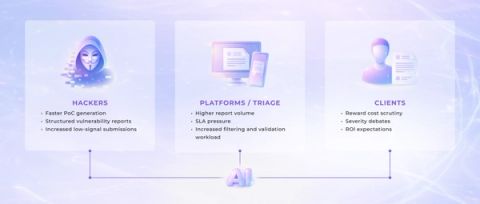
From the Perspective of Hackers
For experienced researchers, AI increases iteration speed and structural clarity.
It supports:
- faster reconnaissance across large repositories
- quicker proof-of-concept scaffolding
- structured vulnerability descriptions
- impact modeling and business-risk articulation
When used responsibly, AI improves report readability and reproducibility. Strong hunters use it to refine communication and test exploit logic before submission.
At the same time, AI lowers the effort required to generate plausible-looking reports. Some submissions include templated descriptions, generalized vulnerability claims, or partially tested PoCs. While not always malicious, these reports often lack depth or reproducibility.
This creates a wider gap between high-signal and low-signal submissions.
From the Perspective of Triage Teams and Platforms
For bug bounty platforms and triage providers, AI introduces operational pressure.
Common challenges include:
- increased volume of AI-assisted submissions
- higher proportion of low-quality or duplicated findings
- longer validation cycles per report
- increased SLA pressure from clients
Even when individual reports are harmless, scale becomes the issue. Platforms must invest more in filtering mechanisms, reproduction standards, and severity calibration processes.
Clients may interpret slower response times as underperformance, even when the underlying cause is submission volume and noise density.
AI therefore increases both throughput and triage complexity.
From the Perspective of Clients
For companies running bug bounty programs, AI affects perception of effort and value.
As exploit hypothesis generation and PoC drafting become faster, some clients question whether high-severity rewards still reflect the level of work required. In certain programs, this leads to downward pressure on payouts — particularly for vulnerabilities perceived as “AI-assisted.”
However, this reasoning can be misleading. While AI may accelerate discovery, exploit validation, economic impact modeling, and responsible disclosure still require skill and contextual understanding.
Reducing rewards purely based on tooling assumptions risks discouraging high-quality researchers and shifting incentives in unintended ways.
Structural Shift
AI does not change the fundamental purpose of bug bounty programs — uncovering real vulnerabilities before attackers do. What it changes is tempo, volume, and signal distribution.
The ecosystem now requires:
- clearer submission standards
- stronger reproducibility requirements
- improved triage automation
- transparent reward policies
Bug bounty in 2026 is not simply faster. It is more polarized: higher potential productivity on one side, and higher noise pressure on the other.
The Next Years: Where Hacking Is Heading
Any forecast in this space is likely to underestimate the pace of change. Over the past five years, AI moved from assistive tooling to operational infrastructure. The next cycle will likely be defined not by incremental improvements, but by systemic shifts in how attacks and defenses are designed.
Three developments stand out.
1. Agentic AI at Scale
Agentic systems are still in early operational stages, but their trajectory is clear. Over the next 3–5 years, these systems are likely to become more coordinated, multi-layered, and outcome-oriented.
Instead of executing isolated tasks, future agentic frameworks may:
- run persistent reconnaissance across evolving codebases
- monitor governance changes and upgrade patterns in real time
- adapt attack hypotheses dynamically based on patch history
- coordinate multi-step attack simulations across contracts and infrastructure
The shift will be from “AI assisting analysis” to “AI orchestrating structured attack planning.” The emphasis will move toward result-driven systems capable of long-horizon planning rather than single-exploit attempts.
2. AI vs AI: The Speed and Creativity Race
The next phase of cybersecurity — including Web3 — will likely be defined by AI competing against AI.
Defensive systems will increasingly:
- detect anomalous contract interactions in real time
- simulate exploit paths pre-deployment
- monitor governance proposals for adversarial logic
At the same time, offensive AI systems will attempt to bypass detection layers through adaptive behavior and pattern mutation.
In this environment, two variables become decisive:
- speed of implementation
- creative adversarial modeling
The winner will not necessarily be the side with the largest model, but the one that integrates AI most effectively into real operational workflows.
3. Quantum + AI: Acceleration Pressure
Quantum computing has long been discussed in relation to cryptography and blockchain security. While practical large-scale quantum attacks remain limited, the integration of AI into research workflows may accelerate progress in quantum algorithm optimization.
AI-assisted modeling could:
- accelerate research in post-quantum cryptography
- optimize quantum simulation strategies
- identify cryptographic edge cases faster
This creates strategic pressure on both Web3 and Web2 infrastructures to prepare for post-quantum resilience earlier than previously projected.
The conversation around quantum risk is no longer theoretical timing — it is about preparation timelines.
Structural Outlook
If the past five years were about AI entering workflows, the next five will be about AI shaping strategy.
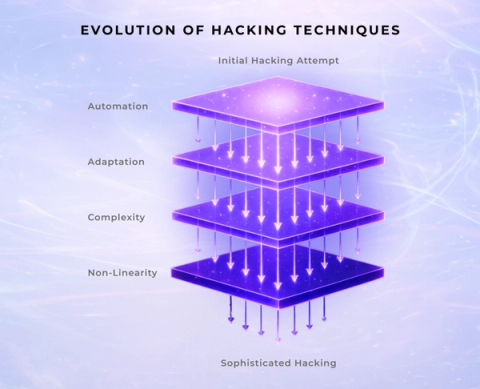
At the same time, defensive systems will evolve in parallel.
The future is unlikely to be human vs machine. It will be human-AI systems competing against other human-AI systems.
Conclusion
Both black hats and white hats are mastering AI. The difference is how that knowledge is applied. Our community channels AI-driven research toward protection, not exploitation. Discover how HackenProof’s Bug Bounty and Dual Defense programs can strengthen your Web3 security posture.
More topics: