'%3e%3cpath%20d='M12.4997%201.33325C10.39%201.33325%208.32772%201.95884%206.5736%203.13091C4.81947%204.30298%203.4523%205.96888%202.64496%207.91796C1.83763%209.86704%201.62639%2012.0118%202.03797%2014.0809C2.44955%2016.15%203.46545%2018.0506%204.95721%2019.5424C6.44897%2021.0342%208.34959%2022.0501%2010.4187%2022.4616C12.4878%2022.8732%2014.6326%2022.662%2016.5816%2021.8546C18.5307%2021.0473%2020.1966%2019.6801%2021.3687%2017.926C22.5408%2016.1719%2023.1663%2014.1096%2023.1663%2011.9999C23.1663%209.17094%2022.0425%206.45783%2020.0422%204.45745C18.0418%202.45706%2015.3287%201.33325%2012.4997%201.33325ZM12.4997%2021.3333C10.6537%2021.3333%208.84922%2020.7859%207.31436%2019.7603C5.7795%2018.7347%204.58322%2017.2771%203.8768%2015.5716C3.17039%2013.8662%202.98555%2011.9896%203.34568%2010.1791C3.70581%208.36859%204.59473%206.70554%205.90002%205.40025C7.20531%204.09496%208.86835%203.20605%2010.6788%202.84592C12.4893%202.48579%2014.3659%202.67063%2016.0714%203.37704C17.7768%204.08346%2019.2345%205.27974%2020.2601%206.8146C21.2856%208.34945%2021.833%2010.154%2021.833%2011.9999C21.833%2014.4753%2020.8497%2016.8492%2019.0993%2018.5996C17.349%2020.3499%2014.975%2021.3333%2012.4997%2021.3333Z'%20fill='white'/%3e%3cpath%20d='M19.167%208.06667C19.042%207.9425%2018.8731%207.8728%2018.697%207.8728C18.5208%207.8728%2018.3519%207.9425%2018.227%208.06667L10.8269%2015.4333L6.82695%2011.4333C6.70495%2011.3016%206.53562%2011.2237%206.35621%2011.2169C6.1768%2011.21%206.00201%2011.2747%205.87028%2011.3967C5.73856%2011.5187%205.66069%2011.688%205.65382%2011.8674C5.64694%2012.0468%205.71162%2012.2216%205.83362%2012.3533L10.8269%2017.3333L19.167%209.01333C19.2294%208.95136%2019.279%208.87762%2019.3129%208.79638C19.3467%208.71514%2019.3642%208.62801%2019.3642%208.54C19.3642%208.45199%2019.3467%208.36485%2019.3129%208.28361C19.279%208.20237%2019.2294%208.12864%2019.167%208.06667Z'%20fill='white'/%3e%3c/g%3e%3cdefs%3e%3cclipPath%20id='clip0_2790_31187'%3e%3crect%20width='24'%20height='24'%20fill='white'%20transform='translate(0.5)'/%3e%3c/clipPath%3e%3c/defs%3e%3c/svg%3e)


What Is a Bug Bounty Program and How Does It Work?

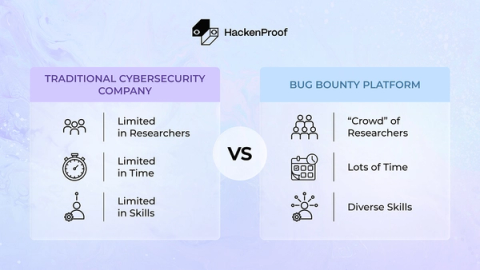
Imagine we have a company named SoftwareCo that wants to check its software for security vulnerabilities. There are two scenarios: one in which SoftwareCo hires a traditional cybersecurity firm, and another in which SoftwareCo works with a bug bounty platform.
Scenario 1—Traditional Cybersecurity Company
SoftwareCo hires a security consulting firm, ProtectCo, to test its software. ProtectCo is a typical consulting service provider with a few dozen employees. ProtectCo will assign a few of its cybersecurity experts to test SoftwareCo’s software for 2-4 weeks. After the assessment, ProtectCo will provide a report listing all vulnerabilities its employees found and hand it over to SoftwareCo. SoftwareCo’s Head of IT will be responsible for fixing the bugs.
That’s the standard flow most companies go through when conducting a security assessment of their digital assets.
Now, let’s take a look at Scenario 2, where SoftwareCo chooses a Bug Bounty Platform (BBP).
Scenario 2—Bug Bounty Platform
Firstly, a bug bounty platform will help SoftwareCo create a Bug Bounty Program Policy—a document that details which resources are in scope/out of scope, the reporting procedure, the rewards for various vulnerabilities, and other rules. Once that’s done, the bug bounty platform will announce to hundreds of its researchers that a bug bounty program for SoftwareCo is live, with a call to action to participate. Dozens of security researchers will be testing SoftwareСo’s digital assets for months (or even years). All vulnerabilities are being reported via the platform. BBP’s triage team validates each report. SoftwareCo can monitor program activity 24/7 and receive live updates on vulnerabilities found and money spent.
As you can see, in Scenario 2, lots and lots of researchers with various backgrounds will test SoftwareCo’s digital assets for a prolonged period of time, greatly reducing the chance that a bug will “slip by.” Traditional security consulting companies simply can’t compete with the talent base available to Bug Bounty Platforms.
Many companies have a mindset of building an “impenetrable wall” around their digital assets that will save them. The reality, however, is different. No matter how great the wall is, hackers will find a weak spot sooner or later and exploit it.
Technology is evolving all the time, and your defense has to keep pace. The right mindset if you don’t want to be hacked is to constantly test your “wall,” find vulnerabilities and fix them, before black hat hackers can exploit them.
Bug bounty is a convenient and efficient way for companies to continuously test the security of their digital assets. So what is a bug bounty program?
What Is a Bug Bounty Program?
A bug bounty program is a structured arrangement where a company invites independent security researchers, often called ethical hackers or white-hat hackers, to search for vulnerabilities in its digital assets. When a researcher finds and responsibly reports a valid security issue, the company pays them a reward, or "bounty," based on the severity of the finding.
The concept is simple: you're essentially crowdsourcing your security testing to a global pool of specialists, each with different skills, tools, and attack perspectives.
Bug bounty programs can cover a wide range of assets like web applications, APIs, mobile apps, login flows, payment systems, admin panels, and more. Companies define the scope, set the rules of engagement, and decide what types of vulnerabilities are eligible for rewards.
This isn't a new idea. Tech giants like Google, Microsoft, and Apple have run bug bounty programs for over a decade. But what's changed is accessibility. Today, platforms exist that allow any company, regardless of size or industry, to launch and manage a program without requiring deep in-house security expertise.
What Are The Main Types of Bug Bounty Programs?
By the Organization Level
Organized by the company itself without the involvement of third parties. The company implements the program with full responsibility and independently determines all the program conditions. For instance, Microsoft regularly launches bug bounty programs on its platform to test the security of its most popular products. For this purpose, companies create separate departments that exclusively deal with the organization and implementation of bug bounty programs.
Organized on an independent platform. Most companies lack the expertise to independently organize and launch a bug bounty program. Therefore, they seek the services of professional platforms.
By the Access Level of Ethical Hackers
Public bug bounty programs. An unlimited number of participants can take part in these programs. The only condition for white hackers is to register on the platform.
Private bug bounty programs. Hackers need to receive a special invitation from the organizer to participate in closed bug bounty programs. Both the program customer and the hosting platform set the criteria for participation in this type of bug bounty program.
What Is The Bug Bounty Program Lifecycle?
Step 1—Bug Bounty Brief Creation
Once a company has settled on a bug bounty platform they want to use, they start working on a document called a Bug Bounty Brief.
The bug bounty brief outlines the rules of engagement for researchers working on a bug bounty program. It’s a company’s responsibility, with the help of a bug bounty platform’s staff, to write a clear brief, and it's the researchers’ responsibility to get accustomed to it before getting started on a program.
Bug bounty brief structure may vary, but it usually contains the following points:
About: A short company description that hosts a bug bounty program. This provides a bit of context for researchers who are going to work on this particular bug bounty program.
Scope: Scope simply states what resources must be tested by researchers. “Where” should researchers be looking for bugs?
Focus: This section deals with “what” researchers should be looking for. This may include specific bug types, functionality, features, etc. Companies provide as much documentation as possible in order to assist hackers in working on a program efficiently.
Out of Scope: Companies also create a list of vulnerabilities they don’t want hackers to be working on. These usually include vulnerabilities that don’t pose a security risk to the client.
Rewards: Usually, companies themselves determine the pricing level for different vulnerability types, but often bug bounty platforms’ staff advise companies on the compensation level, in order to make the bug bounty program attractive to the researchers.
Bug Bounty Rules: This section describes in detail what researchers can and cannot do when working on this particular bug bounty program and what disclosure guidelines they should follow.
Service Level Agreement: Details how the company communicates and pays researchers during the bug bounty program.
A bug bounty brief is a complex document and an integral part of the lifecycle of a bug bounty program. If companies get this part wrong, they will likely fail to have a successful bug bounty program.
Step 2—Bug Bounty Program Launch
Once a bug bounty brief has been created, it is published on a bug bounty program page, and it becomes “live.” Bug bounty platforms conduct marketing activities in order to attract white-hat hackers to this particular bug bounty program.
Step 3—Let The Hacking Begin
Once the bug bounty program has begun, white-hat hackers start testing the software and report bugs they find. Researchers write up a bug report explaining in detail how to exploit a vulnerability and submit it via the platform’s website.
Step 4—Bugs Are Being Verified By An In-House Triage Team
Every bug bounty platform has a team of in-house cybersecurity specialists called the “Triage Team.” The triage team's job is to verify bugs reported by researchers and determine their severity level for the client.
Step 5—Fixing The Bugs
The security team within the customer’s company receives a report from the bug bounty platform with an explanation of how to fix the vulnerability. Once the fix has been verified by the researcher who filed the bug in the first place, the client pays the researcher. Additionally, the researcher gets reputation points on the platform.
Business Benefits of a Bug Bounty Program
A bug bounty program helps businesses improve security by using external experts to find problems before criminals do. The key benefits include:
- Better Security Coverage: Internal security teams have limits. A bug bounty program brings in security researchers with different skills, increasing the chances of finding critical issues.
- Stronger Customer Trust: Proactive security efforts show a commitment to protecting users and data, improving reputation.
- Faster Issue Detection: Traditional security checks run on a schedule, but bug bounty programs run continuously, allowing businesses to catch risks sooner.
Cost Comparison: Bug Bounty vs. Traditional Security
A bug bounty program is often more affordable than hiring full-time security testers. Businesses pay for real security risks instead of spending a fixed budget on security reviews that may miss critical gaps.
| Security Approach | Cost Structure | Efficiency | Coverage |
|---|---|---|---|
Security breach | In 2025, Robinhood agreed to pay $45 million in fines due to a 2021 data breach and record-keeping | Significant financial loss, reputational damage, and operational disruption. | Affects multiple areas of the organization, often leading to long-term negative consequences. |
Traditional Penetration Testing | Fixed costs ranging from $10,000 to $30,000 per engagement, regardless of findings. | Provides a comprehensive, point-in-time assessment by a dedicated team of professionals. | Limited to the predefined scope and duration of the engagement. |
Bug Bounty Program | Variable costs based on valid vulnerabilities found; average payouts are $1,000, with critical issues commanding higher rewards. | Leverages a global pool of researchers, offering diverse perspectives and continuous testing. | Offers ongoing assessment across a broad scope, adapting to emerging threats and system changes. |
The pay-for-results model of a bug bounty program makes it a flexible security solution. Instead of spending a set amount on testing, businesses only pay when real weaknesses are found.
Risk Management Strategies with Bug Bounties
A bug bounty program helps businesses manage security risks effectively. To get the best results, companies should:
- Define Clear Rules: Set clear guidelines on what areas testers can check, how reports should be submitted, and how rewards will be given. HackenProof’s policy guidelines provide a strong example.
- Offer Competitive Rewards: The best security researchers focus on programs with fair payments. Bug bounty leaderboards show how top hackers earn high rewards.
- Prioritize Fixes: Security issues should be fixed quickly based on how serious they are. A good bug bounty program includes a process for ranking and handling issues. Companies like Near and Aptos have successfully implemented structured vulnerability management.
- Use a Trusted Platform: Running a bug bounty program through a platform ensures smooth communication between businesses and researchers.
Bug Bounty Programs for the Government Sector
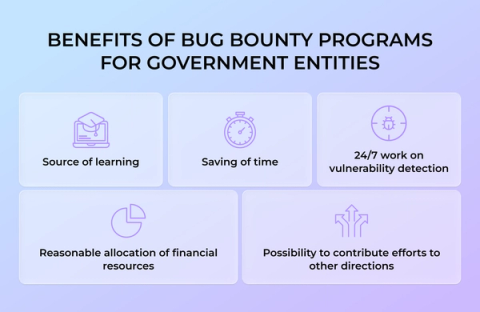
Governments are interested in running bug bounty programs since this form of security testing allows them to achieve the desired high-quality outcomes in a fast and financially efficient way. Instead of maintaining a huge internal staff of high-paid cybersecurity specialists, a government, when required, organizes a bug bounty program and pays ethical researchers only for revealed bugs.
Non-required expenditures are not related to bug bounty programs. At the same time, reputable bug bounty platforms are interested in cooperating only with highly professional ethical researchers, and that is why governments applying for bug bounty programs face minimal security and disclosure risks.
Government Bug Bounty Programs
The most famous examples of bug bounty programs launched by government sector agencies are the “Hack the Pentagon” program initiated by the U.S. Department of Defense, the Security Vulnerability disclosure program by Bundeswehr (German Armed Forces), the bug bounty program by Swiss Post, and others.
At the same time, a government may also establish state-backed bug bounty platforms such as the ones operating in Kazakhstan and Saudi Arabia. For government agencies, the ultimate security of citizens’ data is a top priority. The fact that they trust ethical researchers is confirmation of high ethical standards followed by bug bounty platforms.
One of the most recent examples of launching a bug bounty program by a government sector agency has taken place in Ukraine. At the end of July 2021, the Ministry of Digital Transformation of Ukraine decided to launch a bug bounty program to test the security of the application Diia, the state online services portal. The total prize pool of this bug bounty program is 1 mln UAH ($35,000). This case is of the greatest interest to the global cybersecurity community. Ukraine has become one of the fastest-growing countries in terms of the pace of digital transformation.
Namely, it has been the first country in the world to fully legalize digital passports and one of the global pioneers in the adoption of blockchain technologies. That is why, based on the information provided above, it’s reasonable to suggest that cooperation between government sector agencies and independent researchers through the mechanism of bug bounty programs is likely to become the future of cybersecurity in both developed and developing countries.
Bug Bounty Programs & HIPAA Compliance Audit
HIPAA regulation states that covered entities should “implement a mechanism to encrypt Protected Health Information (PHI) whenever deemed appropriate.” The main goal of encryption is to prevent unauthorized users from viewing PHI. The HIPAA regulation generally does not treat any safeguard measure as the only appropriate tool for protecting PHI. That is why covered entities are free to decide what security measures to apply. HIPAA provisions were written with the understanding that new security technologies and methods would inevitably appear, and a bug bounty program has become one of them.
The entities that want to be fully HIPAA compliant need to focus on ensuring that patients’ private data are protected not only at the stage of transmission but also 24/7, wherever they can be stored. In general, end-to-end encryption is just one of the tools used to protect transmitted information, while only adequately performed security testing, like the one carried out in the form of a bug bounty program, can make entities fully eligible for getting HIPAA compliance status.
The U.S. Department of Health and Human Services (HHS) carries out periodic audits of covered entities and business associates for their compliance with HIPAA. The main aspects of HIPAA compliance are the adequate safeguarding of protected health information (PHI) and the implementation of the HIPAA Security Rule requirements for risk analysis and risk management.
Under the Security Management Process standard in the Security Rule, organizations are required to “implement policies and procedures to prevent, detect, contain, and correct security violations.” A bug bounty program is a process that provides for meeting all these objectives since white hat hackers not only detect vulnerabilities but also inform entities on how to fix them and then test fixes.
To become eligible for HIPAA-compliant organization status, they also need to assess the potential threats to their information systems containing e-PHI. A bug bounty program is a process by which companies may get an understanding of the scope of security risks in a documented form (reports). Thus, the completion of a bug bounty program will serve as confirmation of the entity’s focus on security assurance. However, before allowing independent researchers to work on detecting vulnerabilities, the entity has to separate the testing environment from the networks containing PHI, since in the case of independent researchers accessing these data, the entity will become the violator of HIPAA.
Entities failing to adhere to HIPAA standards face financial penalties and are forced to address issues by the Department of Health and Human Services’ Office for Civil Rights (OCR) and state attorneys general. Penalties are imposed on covered entities to ensure that they are held responsible for certain actions or their absence. The sum of the penalty depends on the seriousness of the violation. In most cases, entities become HIPAA violators due to risk assessment failures. The sum of financial fines imposed on covered entities ranges between $100 and $50,000, but for critical violations, these figures may be much higher. When an entity can prove that a reasonable amount of care has been taken to abide by HIPAA rules, then the sum of financial penalties will be minimal, or authorities may even decide not to impose any punitive measures.
In January 2021, the Lifetime Healthcare Companies, including its affiliate Excellus Health Plan, agreed to pay a $5.1 million fine for the failure to prevent the data breach affecting 9.3 million people caused by unauthorized access to the information systems by cybercriminals. The organization has also agreed to implement a corrective action plan.
In October 2020, Aetna Life Insurance Company and affiliated covered entity (Aetna) agreed to pay a $1 million fine for the failure to guarantee the protection of clients’ data. The plan-related documents displayed on two web services for health plan members could be accessed without login credentials. In September 2020, Orthopedic Clinic paid a $1.5 million fine for non-compliance with HIPAA.
In 2016, a malicious actor accessed the entity’s electronic medical record system and stole data belonging to more than 200K patients. According to the results of the investigation, the data breach was caused by the entity’s failure to conduct regular risk analysis, implement risk management, and perform regular audit controls.
If the above-mentioned entities had run regular bug bounty programs, they would have avoided these huge penalties or at least faced much lower fines. The more effort entities contribute to strengthening their security, the lower their chances of being affected by data breaches and, thus, facing huge financial penalties.
Bug Bounty Program & GDPR Compliance Audit
Under the General Data Protection Regulation (Recital 83), entities are recommended to implement measures such as encryption to mitigate the risks associated with data processing, and thus, this instrument may not be referred to as mandatory. That is why the use of encryption does not obligatorily make companies GDPR-compliant. At the same time, under Article 32, companies have to take appropriate technical and organizational measures to ensure data protection. In this context, both bug bounty programs and encryption may be viewed as security measures by implementing which companies can get closer to becoming GDPR compliant.
- Encryption makes data unreadable for unauthorized users and is widely used when transferring information.
- Although encryption may be viewed as a highly recommended measure to ensure data security, it does not guarantee 100% protection of personal information since there is always the risk that human mistakes or improper implementation can lead to data leaks.
That is why it is highly recommended for companies to apply for bug bounty programs to identify the channels through which data leaks may take place. Generally, bug bounty programs and data encryption are the 2 security measures that complement rather than substitute each other.
Although there is no precise algorithm by implementing which companies can become GDPR compliant, there is a list of basic recommendations following which companies can significantly increase their chances of passing the GDPR compliance audit. Companies need to take into account data protection from the time they start working with information. Since the bug bounty program is a continuous security testing instrument, it may serve as a great confirmation for authorities of the data controller’s focus on security. By running bug bounty programs, companies build awareness about data protection among their employees.
Besides, when preparing to run a bug bounty program on professional platforms, companies conduct information audits to determine how much information they have and where they store it. By completing these activities, companies become more transparent, which is also one of the required conditions to become GDPR compliant.
And, what is most important, bug bounty programs allow companies to detect and eliminate critical and high-severity vulnerabilities and bugs, the exploitation of which by malicious actors may result in data theft and leaks. As a result, companies can increase the level of protection of the information they work with. Generally, by preparing for and running bug bounty programs, companies may meet some of the main requirements to become GDPR compliant.
When companies fail to ensure the protection of clients’ information, under the GDPR, they can face financial penalties. Generally, there are 2 levels of fines depending on the severity of violations. For less severe infringements, the company that has violated the GDPR provisions has to pay fines of up to €10 million or 2% of its annual worldwide revenues, whichever amount is higher. For more serious infringements, the company that has violated the GDPR provisions has to pay fines of up to €20 million or 4% of its annual worldwide revenues, whichever amount is higher. The fines are administered by the data protection regulators of each EU country. The amount of fines imposed on a company depends on 10 criteria, including whether the company has taken adequate precautionary measures. In this case, by running bug bounty programs, companies may show that they have taken serious precautionary measures to prevent data theft and leaks, and, as a result, the sum of fines they will have to pay in case of data infringement will be reduced.
In 2020, British Airways was fined £20 million by the Information Commissioner’s Office for its failure to take appropriate security measures to prevent the data breach that took place in 2018. As a result of this breach, the data belonging to 400,000+ customers was compromised. It took the company over 2 months to detect the attack. According to the ICO, the company did not undertake appropriate rigorous testing in the form of simulations of cyberattacks.
In 2019, Bulgaria’s data protection authority, the Commission for Personal Data Protection, imposed a fine of over €2.6 million on the country’s National Revenue Agency (NRA) for its failure to prevent a personal data breach. The data breach affected over 5 million Bulgarian citizens. The national authority recommended that the NRA enhance its data protection mechanism to prevent the occurrence of similar incidents in the future. Consequently, it is reasonable to suggest that by running bug bounty programs, entities can avoid facing financial fines of up to a few million USD.
Bug Bounty Program & PCI DSS Compliance Audit
Under PCI DSS Requirement 3, companies are obliged to avoid sending PAN (primary account number) in unencrypted messages and are strongly recommended to encrypt every piece of information they need to store. However, end-to-end encryption is just one of the measures companies should take to become PCI DSS compliant. The use of bug bounty programs allows companies to identify weaknesses, the exploitation of which may allow attackers to access sensitive data and files located in the companies’ storage.
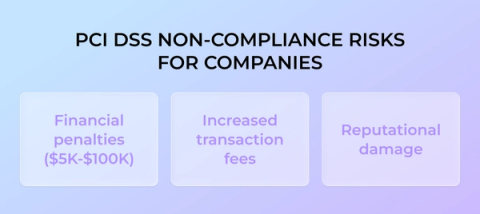
To become PCI DSS compliant, entities processing debit/credit card payments have to achieve 6 separate goals—the PCI Security Standards. For example, entities need to regularly test security systems and processes, protect stored cardholder data, and restrict access to cardholder data. The bug bounty program is a security testing mechanism through which, on a regular basis, companies can meet some of the key PCI Security Standards. Also, bug bounty programs may allow companies to detect issues in their access control systems, networks, and security policies.
To become PCI DSS compliant, companies need to prove their ability to prevent data breaches, and bug bounty programs are measures that allow companies to identify and eliminate the channels through which malicious actors can gain access to and steal the sensitive data stored by entities.
Top 5 Bug Bounty Myths
Myth number 1: Only large companies run bug bounty programs
That used to be correct in the past, for a simple reason—only large companies had both the media presence and qualified personnel to successfully conduct bug bounty programs. With the rise of bug bounty platforms, that’s not the case anymore. Bug bounty platforms help almost any kind of business launch and manage successful bug bounty programs.
As products and companies grow, it becomes more difficult to maintain an adequate level of security. At scale, bug bounty programs become more and more cost-efficient compared to conventional penetration testing.
Myth number 2: Hackers can’t be trusted
This is quite a common misconception among the business community. We hear it all the time: “How can you guarantee that cybersecurity researchers won’t take vulnerabilities they find and sell them on the black market?” Quite a reasonable concern. There are two main points companies should bear in mind when it comes to white hat hackers:
1) White hat hackers are public figures. Being public is “part of the game”
We’ve interviewed a lot of white hat hackers during our work, and we constantly ask them the question, “Why have you chosen a white hat hacker path?”
Their responses are always the same: “I don’t want to go to jail.” Researchers genuinely enjoy what they do on a daily basis. They don’t want that to stop. The overwhelming majority states that they don’t do it for the money, but because they enjoy looking for vulnerabilities in software products.
2) Legal bug hunting means you can gradually build a reputation
Another big advantage of being a white hat is that one can continuously build up their reputation as time goes by. With every vulnerability found, a white-hat hacker gains reputation points, as well as monetary rewards (that can be tens of thousands of dollars per vulnerability in some cases.) Bug bounty platforms feature leaderboards, where cybersecurity researchers compete with each other. Bug Bounty platforms award top researchers with custom merchandise. After a certain amount of time, successful researchers become influencers and are asked to give talks at conferences and are invited to participate in bug bounty hackathons across the globe.
3) Selling vulnerabilities on the black market, in most cases, doesn’t make any sense
The black market is not interested in either low or medium vulnerabilities. Selling them on the black market would be close to impossible. At the same time, companies are prepared to pay top dollar for critical vulnerabilities on their bug bounty programs. Bounties for Remote Code Execution can easily cost tens of thousands of dollars.
In addition, the black market is a hostile place, where people get scammed all the time, so selling anything on it is not exactly a walk in the park.
So, to sum up, selling vulnerabilities to companies via bug bounty programs is easy, legal, and can make researchers a lot of money.
4) Background checks
For clients seeking an extra layer of confidence, we offer private bug bounty programs. We hand-pick researchers that we’ve verified personally, and we can also conduct background checks upon the client’s request.
Myth number 3: Bug bounty programs don’t yield results
This myth is easy to bust by looking at the numbers. Let’s start with the big companies that everyone is familiar with. A recent report says:
- Google has paid more than $12 million to bug hunters since 2010
- Facebook has received more than 12,000 submissions from researchers in 2017 alone! Bounties paid since 2011 exceed $6 million.
Both Facebook and Google wouldn’t have spent their time on bug bounty programs if they didn’t yield results.
Here is a quote from one of our existing clients that reflects their experience with a bug bounty program. This is what Vitaliy Diatlenko (CTO of the biggest ride-sharing app in Ukraine, Uklon) has to say about his experience at the onsite bug bounty marathon “Hacken Cup”:
“It’s been a great decision for Uklon to participate in an onsite bug bounty marathon—Hacken Cup. For 9 hours, 25 ethical hackers have been testing our website and mobile apps. Throughout the whole day, Uklon’s technical team has been discussing reported vulnerabilities with hackers who were present at the event. We have been genuinely surprised by the amount of work they have managed to do in a single day. I think that Bug Bounty Programs are a great and cost-efficient way to strengthen security for large and mature companies.”
During the Hacken Cup hackathon, our white-hat hackers have managed to report 30 verified vulnerabilities in just 9 hours of hacking. Conventional penetration testing would never yield comparable results in such a short period of time.
In addition, as Vitaliy points out, during an on-site bug bounty event, companies have a unique opportunity to talk to white-hat hackers directly. These interactions are very important, as they give companies the opportunity to see how real hackers plan their attacks.
Bug bounty programs are so effective because hundreds of cybersecurity experts test clients’ software for a prolonged period of time. Researchers on our platform have different backgrounds (web, mobile, IoT, smart contracts, hardware). That means that the chance of a bug “slipping by” is reduced to a minimum.
Myth number 4: They are too expensive and hard to budget compared to penetration testing
It’s important to look at the pricing policy of a bug bounty program, compared to penetration testing:
1) During a bug bounty program, companies pay only for verified vulnerabilities
During conventional penetration testing, companies pay for the procedure itself, regardless of how many vulnerabilities are found during the process. Bug bounty programs, however, pay bounties to white hat hackers only for verified vulnerabilities.
2) The client is in control of the budget at all times
Companies can easily put a “limit” on the bug bounty budget if they wish to do so. That way, a company can be certain that payments to researchers won’t go “out of control.”
Myth number 5: Bug bounties are hard to run and manage
During a bug bounty program, companies usually prefer to “outsource” all the daily management processes to a specialized team. By doing so, companies don’t have to distract their in-house technical team. Here’s how the whole process works when launching a managed bug bounty program:
- A bug bounty policy is published on a bug bounty platform’s website, and white-hat hackers start looking for vulnerabilities within the scope of the program.
- White-hat hackers find and report vulnerabilities through a bug bounty platform website.
- A bug bounty platform triage team verifies all vulnerabilities that are being sent by researchers and prepares reports for a client. Reports contain a description of a vulnerability and detailed instructions on what needs to be done in order to fix the problem.
Managed bug bounty programs save companies a ton of time by taking on daily communications with white-hat hackers who report vulnerabilities. The larger the company’s digital footprint, the more time can be saved by a managed bug bounty program.
Conclusion
Security breaches don't announce themselves in advance. Bug bounty programs give traditional businesses a way to find the cracks before someone else does, without the overhead of a massive in-house security operation.
In a world where customer data is a liability and regulatory pressure is increasing, the question isn't whether you can afford to run a bug bounty program. It's whether you can afford not to.
Frequently Asked Questions
What is a bug bounty?
A bug bounty is a financial reward offered by an organization to a security researcher who discovers and responsibly reports a vulnerability in its systems. The term is shorthand for a bug bounty program—a formalized initiative with defined scope, rules, and reward tiers.
What are bug bounty programs used for?
Bug bounty programs are used to continuously surface vulnerabilities across an organization's attack surface—web applications, APIs, mobile apps, smart contracts, and infrastructure. They complement existing security controls by adding continuous, adversarial testing from a diverse global researcher community.
What is the difference between a public and private bug bounty program?
A public program is open to any registered security researcher. A private (invite-only) program restricts participation to a vetted group selected by the company or platform. Private programs give companies tighter control over report volume and are typically the recommended starting point for organizations new to bug bounty.
How does a bug bounty program work?
A company defines scope, sets reward tiers, and publishes the program on a platform. Researchers probe the defined systems and submit reports for any vulnerabilities they find. The company reviews each submission, patches valid findings, and pays the corresponding bounty. The platform handles triage and payments.
How much do bug bounty programs cost?
Bounty payouts range from $50–$500 for low-severity findings to $5,000–$100,000+ for critical vulnerabilities. Most platforms also charge a service fee on top of bounties. Unlike retainer-based security testing, you only pay when a valid vulnerability is found.
How do I start a bug bounty program?
The fastest path is through a managed platform like HackenProof. Define your scope, set reward tiers, and the platform handles researcher access, triage, and payouts. Most companies start with a private program and expand once the internal review process is validated.
More topics: