'%3e%3cpath%20d='M12.4997%201.33325C10.39%201.33325%208.32772%201.95884%206.5736%203.13091C4.81947%204.30298%203.4523%205.96888%202.64496%207.91796C1.83763%209.86704%201.62639%2012.0118%202.03797%2014.0809C2.44955%2016.15%203.46545%2018.0506%204.95721%2019.5424C6.44897%2021.0342%208.34959%2022.0501%2010.4187%2022.4616C12.4878%2022.8732%2014.6326%2022.662%2016.5816%2021.8546C18.5307%2021.0473%2020.1966%2019.6801%2021.3687%2017.926C22.5408%2016.1719%2023.1663%2014.1096%2023.1663%2011.9999C23.1663%209.17094%2022.0425%206.45783%2020.0422%204.45745C18.0418%202.45706%2015.3287%201.33325%2012.4997%201.33325ZM12.4997%2021.3333C10.6537%2021.3333%208.84922%2020.7859%207.31436%2019.7603C5.7795%2018.7347%204.58322%2017.2771%203.8768%2015.5716C3.17039%2013.8662%202.98555%2011.9896%203.34568%2010.1791C3.70581%208.36859%204.59473%206.70554%205.90002%205.40025C7.20531%204.09496%208.86835%203.20605%2010.6788%202.84592C12.4893%202.48579%2014.3659%202.67063%2016.0714%203.37704C17.7768%204.08346%2019.2345%205.27974%2020.2601%206.8146C21.2856%208.34945%2021.833%2010.154%2021.833%2011.9999C21.833%2014.4753%2020.8497%2016.8492%2019.0993%2018.5996C17.349%2020.3499%2014.975%2021.3333%2012.4997%2021.3333Z'%20fill='white'/%3e%3cpath%20d='M19.167%208.06667C19.042%207.9425%2018.8731%207.8728%2018.697%207.8728C18.5208%207.8728%2018.3519%207.9425%2018.227%208.06667L10.8269%2015.4333L6.82695%2011.4333C6.70495%2011.3016%206.53562%2011.2237%206.35621%2011.2169C6.1768%2011.21%206.00201%2011.2747%205.87028%2011.3967C5.73856%2011.5187%205.66069%2011.688%205.65382%2011.8674C5.64694%2012.0468%205.71162%2012.2216%205.83362%2012.3533L10.8269%2017.3333L19.167%209.01333C19.2294%208.95136%2019.279%208.87762%2019.3129%208.79638C19.3467%208.71514%2019.3642%208.62801%2019.3642%208.54C19.3642%208.45199%2019.3467%208.36485%2019.3129%208.28361C19.279%208.20237%2019.2294%208.12864%2019.167%208.06667Z'%20fill='white'/%3e%3c/g%3e%3cdefs%3e%3cclipPath%20id='clip0_2790_31187'%3e%3crect%20width='24'%20height='24'%20fill='white'%20transform='translate(0.5)'/%3e%3c/clipPath%3e%3c/defs%3e%3c/svg%3e)


1,100+ Valid Critical Vulnerabilities Later: The Case for Bug Bounty as Investment

Introduction
In April 2026, the ten largest exploits in Web3 combined for over $638 million in losses. Two incidents alone—Kelp DAO ($292 million) and Drift Protocol ($285 million)—accounted for nearly 90% of that total. Both were access control failures, not smart contract bugs.
This is not an anomaly. It is a pattern.
Access control failures, compromised signers, and operational security gaps have consistently outpaced smart contract vulnerabilities as the dominant loss category in Web3. Yet the industry's default security response remains the same: commission an audit before launch, obtain a certificate, and consider the box checked.
The problem is not that audits are ineffective. It is that they are bounded. An audit reviews the code that exists at a specific point in time, within a defined scope, by a team that cannot account for how that code will behave once it is live, integrated, upgraded, and exposed to real adversarial conditions. The moment a protocol goes live, the audit becomes history.
Every month that passes without a continuous security layer is a month when new vulnerabilities—in updated contracts, new integrations, and operational processes—go unmonitored. The April 2026 losses happened to projects that existed, had users, and presumably had security reviews. What most of them did not have was a mechanism for ongoing, adversarial scrutiny after deployment.
That mechanism is a bug bounty program. Not as an alternative to auditing—but as the only layer of security designed to work continuously, after launch, against a live and evolving system.
What a Single Critical Vulnerability Actually Costs
The core economic argument for a bug bounty program is simple: the cost of a validated Critical report is a fraction of the cost of a live exploit. Understanding the gap between those two numbers is where the investment case begins.
The cost of finding a vulnerability responsibly
On HackenProof, the average security researcher payout for a confirmed critical vulnerability is approximately $22,000. That is the price of a controlled disclosure: a researcher finds the issue, submits it through the platform, the finding is triaged and verified, the team patches it, and the vulnerability is closed before anyone outside the program is aware it existed. No public incident, no user funds at risk, no emergency response.
Across the platform’s lifetime, HackenProof has validated 1,100+ Critical findings through responsible disclosure. Each of these findings represents a vulnerability that could have created serious financial, operational, or reputational damage if discovered by an attacker first. Across all severity levels, HackenProof has paid out $26 million+ in bounties—turning potential exploit risk into a controlled, measurable security investment.
The cost of not finding it first
When a critical vulnerability reaches an attacker before a researcher, the economics invert entirely. According to CertiK's 2025 security research, the average loss per exploit incident reached $5.32 million—up 66% year-over-year. That figure represents direct theft from smart contract and protocol exploits, excluding the broader category of key compromise and operational failures, which carry their own separate cost profile and are not the primary target of bug bounty programs.
A security researcher's $22,000 bounty payout versus a $5.32 million average exploit loss is not a close comparison. But the financial loss is only the beginning.
The secondary cost of a public exploit
What the incident report numbers do not capture is everything that follows a public exploit. Token markets respond immediately and persistently—projects that experience security incidents typically see sustained price depression that outlasts the initial shock, directly eroding treasury reserves and the team's ability to hire, fund development, and execute on a roadmap. User trust, once broken by a public exploit, does not recover on a schedule. Investors and partners recalibrate their exposure.
Legal and compliance exposure materializes, particularly as regulatory frameworks in the EU and US increasingly require documented security practices. The internal cost—incident response, remediation, security leadership turnover, and the organizational drag of operating in crisis mode—routinely consumes months of forward progress that cannot be recovered.
None of these secondary costs appear in the theft figure. All of them are real, and all of them follow from a vulnerability that was discoverable before the exploit and was not found in time.
What a Bug Bounty Program Is, and How It Works in Practice
A bug bounty program is a structured way for independent security researchers and security audit teams to find and responsibly report vulnerabilities before attackers exploit them.
Instead of relying only on one-time reviews, companies create a continuous channel for vulnerability discovery, validation, prioritization, and remediation.
The process is simple:
1. Define the scope
The company decides which assets are open for testing: smart contracts, APIs, applications, infrastructure, or other systems.
2. Set the severity framework
Each vulnerability type is mapped to a severity level and reward range.
3. Receive researcher reports
Security researchers submit findings through the platform.
4. Triage and validate
Each report is reviewed to confirm whether the issue is valid, in scope, and relevant to the business risk.
5. Fix and reward
Valid findings are shared with the company with clear remediation context. Researchers are rewarded based on severity.
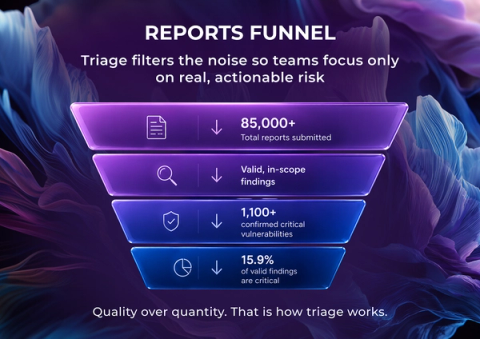
Invalid, duplicate, or out-of-scope reports are filtered out during triage, so the company can focus on real, actionable risk—not noise.
What Nine Years of Bug Bounty Programs Produce
HackenProof has been running bug bounty programs since August 2017—nine years of continuous operation. That makes it one of the longest-operating bug bounty platforms in the industry. The data accumulated over those nine years is the clearest argument for what continuous coverage actually produces.
Platform scale:
- 400+ programs hosted across the platform's lifetime
- $26 million+ in publicly disclosed bounty payouts
- Among programs that have been active for five or more years, 94.3% have produced at least one confirmed critical finding
- 82,000+ registered security researchers on the platform
Across more than 85,000 total reports submitted through HackenProof, roughly 1 in 73 is rated Critical. That may sound like a small share, but it reflects how triage is supposed to work: the majority of submissions are lower severity or out of scope, and the platform filters that noise so security teams only act on verified, in-scope risk. Among reports that are ultimately validated, Critical vulnerabilities represent 15.9% of findings, highlighting the concentration of risk within high-quality submissions.
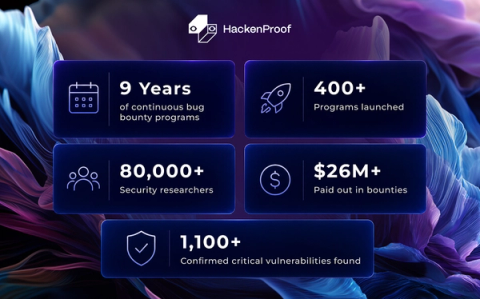
That is 1,100+ confirmed critical vulnerabilities removed from production systems through responsible disclosure—509 in Web3 (smart contracts, blockchain protocols, DeFi) and 590+ in Web2 (web applications, APIs, mobile, infrastructure). At an average hack cost of $24.5 million, the counterfactual is not a comfortable number.
For context: Immunefi's CEO recently published a platform comparison estimating HackenProof's total critical finding count at 79. The actual internal figure is 1,100+—more than 14 times their estimate. The gap reflects the difference between publicly visible bounty data and the full scope of what a platform covering both Web3 and Web2 actually processes.
Web2 Digital Products + Web3 coverage: Unlike most crypto-native bug bounty platforms, HackenProof covers the full product stack—smart contracts, blockchain protocols, web applications, APIs, mobile apps, and infrastructure. Security incidents do not respect the Web2/Web3 boundary, and neither does the coverage.
Five Reasons to Launch a Bug Bounty Program Now
1. The regulatory floor is rising
Several regulatory frameworks and international standards now require or strongly imply ongoing vulnerability management practices:
- NIS2 Compliance—EU directive requiring financial and critical infrastructure entities to implement continuous cybersecurity risk management and incident handling
- DORA Compliance—EU regulation mandating digital operational resilience for financial sector entities, including regular security testing and vulnerability management
- ISO/IEC 27001—requirements for establishing and maintaining an information security management system
- ISO/IEC 27002—controls and guidance for information security practices
- ISO/IEC 29147—guidelines for vulnerability disclosure
- ISO/IEC 30111—processes for handling and resolving reported vulnerabilities
A running bug bounty program aligned with these standards is a concrete, auditable proof point of continuous security coverage that satisfies both regulatory and institutional requirements.
2. Hack frequency has stabilized—and the tail risk has gotten worse
The industry is not getting safer at the rate that TVL and user exposure are growing. With 94 to 97 hacks per year as the new normal, and the five largest exploits accounting for 62% of total losses, the question is not whether projects get attacked. It is whether attackers find the vulnerabilities before researchers do.
3. A public bug bounty program sends a market signal
Launching a bug bounty program communicates to investors, partners, and users that the project is willing to pay for security findings rather than suppress them. This is increasingly a standard component of institutional due diligence in Web3 and a visible differentiator in a market where security track record matters
4. Crowdsourced coverage that no internal team can replicate
82,000+ active independent researchers with different tooling, methodologies, backgrounds, and attack intuitions. A pentest buys a fixed amount of expert time. A bug bounty program buys ongoing access to a competitive global pool and only pays for results.
5. The ROI math is straightforward
The average payout for a confirmed critical vulnerability on HackenProof is $22,000. The average cost of a crypto exploit is $24.5 million in direct theft alone—making the typical critical bounty payout more than 1,100 times cheaper than the incident it prevents. And that figure doesn't include the reputational damage, token price impact, and organizational disruption that follow every public exploit. HackenProof has paid out more than $26 million in bounties across eight years of platform operation. A single average exploit exceeds that entire historical total. The question is not whether a bug bounty program is affordable. It is whether the absence of one is.
What Makes HackenProof Different in Practice
A few things distinguish how HackenProof is set up that are worth understanding before making a platform decision.
HackenProof is the #1 bug bounty platform for CEXs and crypto wallets worldwide—the two asset categories that have consistently accounted for the largest share of industry losses. It ranks among the top 3 security providers globally for smart contract and blockchain security.
Most bug bounty platforms in the Web3 space cover smart contracts and blockchain infrastructure. HackenProof covers the full stack—contracts, protocols, web applications, APIs, mobile, and backend systems. Given that access control failures and Web2-layer vulnerabilities account for more than half of recorded Web3 losses, coverage that stops at the contract layer has a significant blind spot.
Over the past nine years, HackenProof has grown a community of more than 82,000 security researchers, supporting over 400 bug bounty programs and facilitating more than $26 million in bounty payouts. During that time, researchers have identified over 1,100 confirmed Critical vulnerabilities across participating organizations.
The platform serves organizations in more than 45 countries, including Web3 projects such as NEAR, 1inch, OKX, MetaMask, Sui, Aurora, and Status, as well as financial institutions and public-sector organizations including Raiffeisen Bank, Meest, Prozorro, SG Forge (Société Générale), the European Commission, EBSI, and INATBA.
Ready to Start? Launch Your Bug Bounty Program in 15 Minutes
Starting a bug bounty program on HackenProof requires three things:
- A defined scope—which systems, contracts, APIs, or applications to cover
- A bounty budget—minimum and maximum payouts per severity tier
- A point of contact for confirmed findings
The platform handles triage, researcher communication, and severity validation from there. A program can be configured and activated in as little as 15 minutes.
More topics: