'%3e%3cpath%20d='M12.4997%201.33325C10.39%201.33325%208.32772%201.95884%206.5736%203.13091C4.81947%204.30298%203.4523%205.96888%202.64496%207.91796C1.83763%209.86704%201.62639%2012.0118%202.03797%2014.0809C2.44955%2016.15%203.46545%2018.0506%204.95721%2019.5424C6.44897%2021.0342%208.34959%2022.0501%2010.4187%2022.4616C12.4878%2022.8732%2014.6326%2022.662%2016.5816%2021.8546C18.5307%2021.0473%2020.1966%2019.6801%2021.3687%2017.926C22.5408%2016.1719%2023.1663%2014.1096%2023.1663%2011.9999C23.1663%209.17094%2022.0425%206.45783%2020.0422%204.45745C18.0418%202.45706%2015.3287%201.33325%2012.4997%201.33325ZM12.4997%2021.3333C10.6537%2021.3333%208.84922%2020.7859%207.31436%2019.7603C5.7795%2018.7347%204.58322%2017.2771%203.8768%2015.5716C3.17039%2013.8662%202.98555%2011.9896%203.34568%2010.1791C3.70581%208.36859%204.59473%206.70554%205.90002%205.40025C7.20531%204.09496%208.86835%203.20605%2010.6788%202.84592C12.4893%202.48579%2014.3659%202.67063%2016.0714%203.37704C17.7768%204.08346%2019.2345%205.27974%2020.2601%206.8146C21.2856%208.34945%2021.833%2010.154%2021.833%2011.9999C21.833%2014.4753%2020.8497%2016.8492%2019.0993%2018.5996C17.349%2020.3499%2014.975%2021.3333%2012.4997%2021.3333Z'%20fill='white'/%3e%3cpath%20d='M19.167%208.06667C19.042%207.9425%2018.8731%207.8728%2018.697%207.8728C18.5208%207.8728%2018.3519%207.9425%2018.227%208.06667L10.8269%2015.4333L6.82695%2011.4333C6.70495%2011.3016%206.53562%2011.2237%206.35621%2011.2169C6.1768%2011.21%206.00201%2011.2747%205.87028%2011.3967C5.73856%2011.5187%205.66069%2011.688%205.65382%2011.8674C5.64694%2012.0468%205.71162%2012.2216%205.83362%2012.3533L10.8269%2017.3333L19.167%209.01333C19.2294%208.95136%2019.279%208.87762%2019.3129%208.79638C19.3467%208.71514%2019.3642%208.62801%2019.3642%208.54C19.3642%208.45199%2019.3467%208.36485%2019.3129%208.28361C19.279%208.20237%2019.2294%208.12864%2019.167%208.06667Z'%20fill='white'/%3e%3c/g%3e%3cdefs%3e%3cclipPath%20id='clip0_2790_31187'%3e%3crect%20width='24'%20height='24'%20fill='white'%20transform='translate(0.5)'/%3e%3c/clipPath%3e%3c/defs%3e%3c/svg%3e)



You just paid $30,000–$150,000 for a smart contract, pentest, or infrastructure audit. The report came back clean, or with a handful of issues your team already fixed. Should you launch now—or is there a cheaper way to make sure the auditor didn't miss anything?
This is a more common dilemma than it sounds. Audits are thorough, but they're still the work of one team, working inside a fixed timeframe, following one methodology. And in security, a second set of eyes rarely hurts—it's the cost that usually stops projects from getting one.
Why One Audit Often Isn't the End of the Story
A professional audit is essential, but it can carry limitations that have less to do with the auditors' skill and more to do with time and circumstances:
- Small team. Most audits involve two to six experts working under time pressure.
- Fixed methodology. Auditors follow established workflows—which means the same patterns get applied repeatedly, and blind spots can develop over time.
- Creative attacks get missed. Real attackers don't follow checklists. They probe unexpected angles that a structured review, by design, has less room to test within a fixed engagement window.
This isn't a knock on any specific audit firm—it's simply how single-team reviews work under real-world time and budget constraints.
In practice, most breaches that happen after a project has already passed an audit come down to a few familiar causes:
- Code changed after the audit—a bug fix, a new feature, or a gas optimization that never went back through review
- Out-of-scope attack surface—admin functions, third-party integrations, or off-chain components that weren't included in the original review
- Unconventional attack paths—creative exploits that a fixed-time, fixed-methodology review didn't happen to test
This is a big part of why a second review is increasingly treated as best practice before major launches or fundraising rounds.
Budget makes this harder than it sounds.
Security budgets are often tight—especially for early-stage teams or during leaner periods. The audit you choose is sometimes the most affordable option, not the most thorough. That can work out fine, but it can also mean a narrower scope, less time on the code, or a less experienced team—any of which raises the odds that something gets missed.
Either way, most teams simply don't have room in the budget for a second full audit—even when they know one would be valuable. That's exactly the gap the options below are meant to close.
Your Four Options for a Second Review
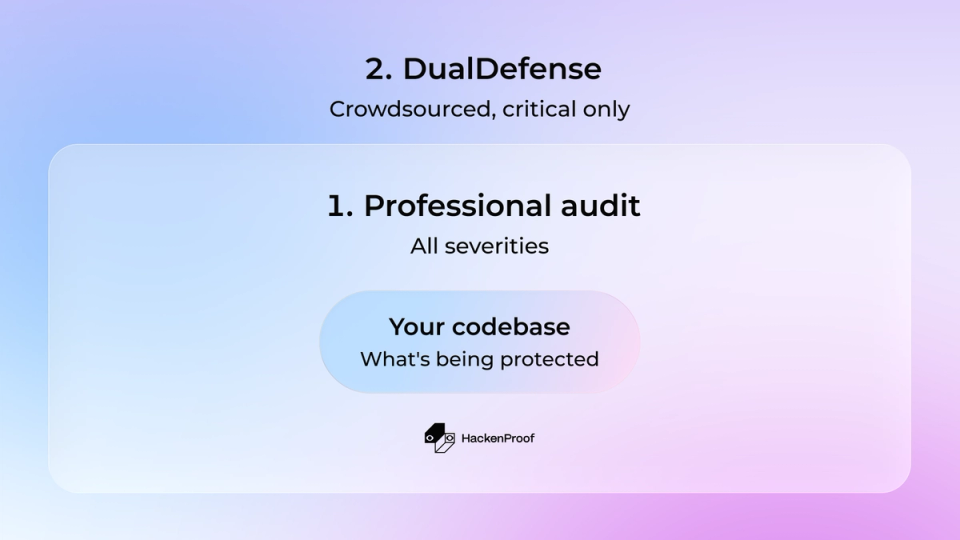
Option 1: A second opinion audit. Hire another firm to review the same codebase from scratch. It works, and it brings a genuinely independent team to the code—but it costs roughly the same as your original audit, takes weeks, and is still, like the first one, the work of two to six auditors within a fixed engagement.
Option 2: An internal review. Have your own developers re-check the code. It's fast and free, but you're essentially asking a team that's already familiar with the codebase—and wasn't the one that caught the original issues—to find what a professional auditor might have missed. Not something to rely on for a critical security decision.
Option 3: A full-scope Crowdsourced Audit. Instead of hiring another small firm, open the entire codebase to a global community of 82,000+ verified security researchers. The scope, budget, and duration are comparable to a traditional full audit—but instead of two to six auditors, hundreds of independent researchers examine the code from different angles, across all severity levels. It's a full second opinion, just driven by community scale rather than a fixed team.
Option 4: DualDefense—a targeted crowdsourced re-check. Same community, narrower focus. HackenProof’s DualDefense opens your already-audited codebase to 1,000+ independent researchers—but scopes the review exclusively to critical vulnerabilities that could lead to loss or permanent lockup of user funds. Because the focus is narrow and the codebase is already documented from the original audit, costs drop significantly, starting at $1,000. Duration scales with codebase size—typically one to four weeks. Built to complement your existing audit, not replace it.
What It Actually Costs, Side by Side
| Second Opinion Audit | Crowdsourced Audit | DualDefense | |
|---|---|---|---|
Cost | ~100% of the original audit | Custom—fixed budget upfront or pay per confirmed finding | 10–20% of the original audit |
Reviewers | 2–6 auditors | 82,000+ researcher community | 1,000+ researchers |
Timeline | Weeks | ~10–35 days (audit phase) | From 7 days |
Focus | All severities | All severities | Critical vulnerabilities only |
Starting price | Custom quote | Custom quote | From $1,000 |
If your original audit cost $10,000, a DualDefense-style review starts at roughly $1,000–$2,000. For that price, a global community of verified researchers stress-tests the same codebase your auditor reviewed—hunting specifically for the critical vulnerabilities that could cause real financial damage, rather than re-litigating every low and medium finding you've already triaged once.
Because a DualDefense program is scoped to critical-severity findings from the outset, researchers are specifically rewarded for critical-level work within that scope—which is also why what lands on your desk is a short, triaged list rather than a mix of severities you'd need to sort through yourself, plus a final report ready to hand to investors or auditors during due diligence.
The price and timeline gap isn't just a discount—it comes from how the two models are structured. A second opinion audit is billed like the first one: by the day, by the auditor, across every severity level, because the firm is starting from scratch. A crowdsourced re-check is priced as a single fixed fee for the whole engagement, scoped to critical findings only, so there's no line item that grows the longer researchers look. The timeline shrinks for a similar reason: researchers aren't onboarding to an unfamiliar codebase from zero—they're working against a scope that's already been mapped and documented by the first audit, which is part of why a review can run in as little as a week instead of the several weeks a second full audit typically takes.
Real Programs, Real Numbers
Worth being specific about who's actually doing the reviewing here. The community isn't just independent freelance researchers—it includes 82,000+ security researchers, 40+ professional auditing companies, and 30+ AI agents, all working the same program, competing both manually and with AI-assisted tooling—proprietary tools as well as mainstream ones like ChatGPT. And when that process turns up a critical vulnerability the original audit missed, it isn't framed as a gotcha aimed at the first auditor. It's a useful signal for them too: a concrete look at exactly where their process had a blind spot, which feeds back into a stronger methodology for their next engagement. The point isn't to embarrass whoever ran the first audit—it's collective scrutiny from a professional community, in service of a shared goal: catching what any single review, however good, always had some chance of missing.
The theory is one thing; what these reviews actually turn up is another.
KiiChain ran a DualDefense program after completing its professional audit. Across the program, 98 security researchers submitted 231 reports and logged 13,072 scope reviews—a level of scrutiny no fixed audit team could match in the same window. The review surfaced 92 high-severity findings and zero criticals, which, rather than being a disappointing result, was itself the value: the team went into launch with independent confirmation that nearly 100 researchers had tried to break the code and hadn't found a critical flaw. As KiiChain's CTO, Jhelison Gabriel Lima Uchoa, put it, the two-layer approach delivered more value than any other security engagement the team had run, and the crowdsourced phase caught things they hadn't anticipated.
Push Chain, reviewing one of the more complex and high-stakes scopes possible—a Layer 1 blockchain—saw an even larger response: over 500 reports from 148 researchers, with 37,823 scope reviews and 92 unique findings identified. That volume of independent scrutiny simply isn't something a traditional audit team, however skilled, can replicate—no six-person team examines a codebase from 37,823 different angles.
Two different outcomes, two different codebases, both useful: one confirmed the original audit's findings held up under far broader scrutiny; the other surfaced a large number of issues a fixed-size audit team was never going to catch alone.
When a Second Review Makes Sense
A targeted, crowdsourced re-check is most valuable at three moments where the cost of being wrong is high and the timeline is short:
- Before launch. The highest-stakes moment for any protocol—a vulnerability discovered after going live can be both a financial and reputational hit. A second review is the last practical checkpoint before that risk becomes real.
- Before fundraising. Investors increasingly expect security evidence as part of due diligence. A report backed by both a professional audit team and a community of 1,000+ independent researchers is a stronger signal than an audit alone.
- Before major updates. Any significant change to already-audited code introduces a new attack surface that the original audit, by definition, never reviewed. Running a targeted check on the updated scope closes that gap.
It's not a replacement for your first audit—you still need a structured, professional review as the baseline. But as a second layer on top of one, it gives you a meaningfully different kind of scrutiny without a meaningfully bigger budget.
The Takeaway
A single audit is necessary—a second, independent look just adds more coverage on top of it. Getting a meaningful second review no longer has to mean paying for a second full audit: a targeted, crowdsourced re-check—run only after your first audit is already done—gives you 1,000+ independent researchers, results from seven days, and pricing that's up to 90% less than a traditional second opinion. An audit tells you what your auditor found. A second, independent look helps surface what a different vantage point might catch that the first one didn't.