1Password Data Breach 2026: What Happened, What Was Stolen, and What Users Should Do

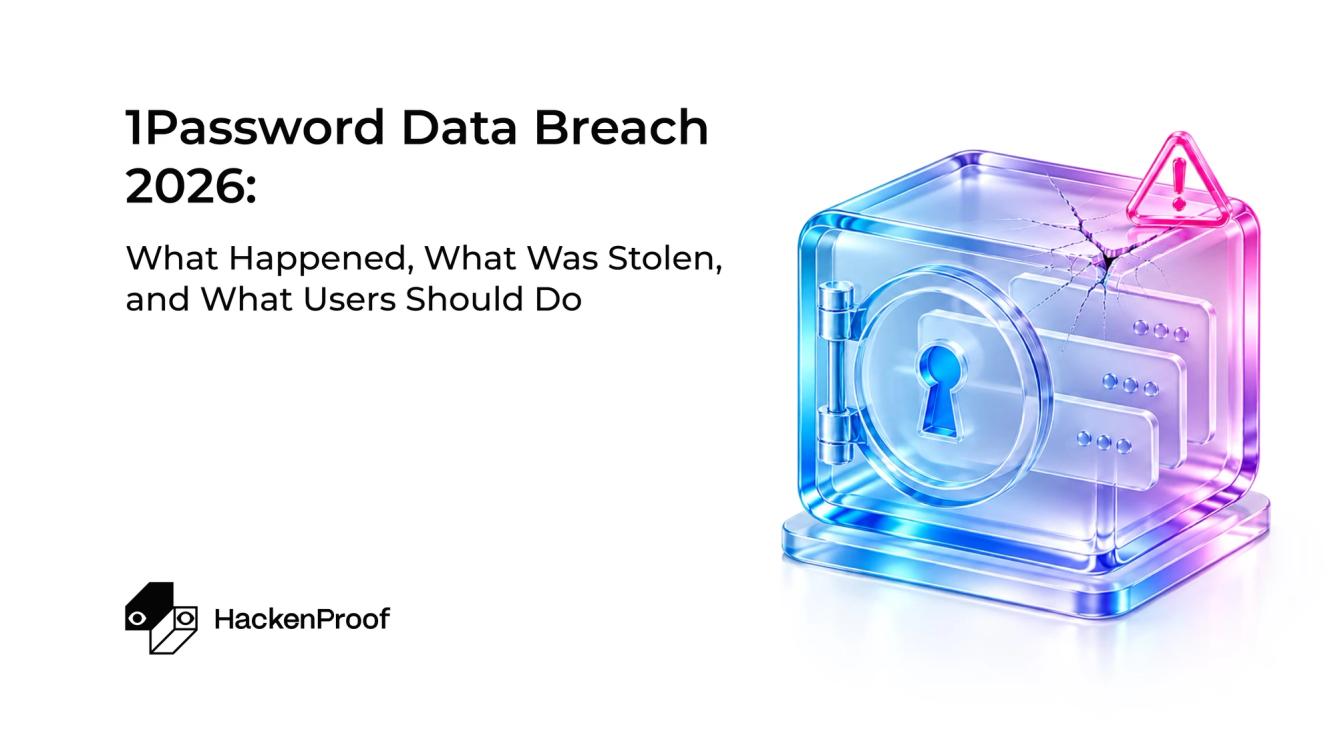
On November 25, 2026, 1Password disclosed a breach of its internal systems. An attacker gained access to an employee’s corporate GitHub account, introduced malicious code into server-side components, and obtained some customer account data. The company also reported unauthorized access to its software development infrastructure. According to 1Password, customers’ passwords, vault contents, and the cryptographic material protecting them were not affected.
For users, the immediate question is whether their passwords are still safe. For security teams, the incident raises a different question: how much damage can a compromised developer identity cause before internal controls intervene?
This article examines the incident, the information exposed, the steps users and businesses can take, and the implications for software development security and vulnerability management. It reflects publicly available information as of November 26, 2026.
What Happened to 1Password in November 2026?
The breach affected part of the company’s internal environment rather than the encryption mechanism used to protect stored passwords. The attacker obtained private source code and access to the continuous integration and delivery (CI/CD) system. The number of affected customers has not been disclosed.
The distinction matters. A password manager handles more than passwords: account administration, invitations, recovery, authentication, and software updates all depend on systems that have their own security requirements. A compromise of those systems can have consequences even when encrypted vaults remain protected.
1Password Data Breach Timeline
November 17: Public trackers recorded a new listing of the 1Password bug bounty program.
November 19: 1Password initiated an investigation into suspicious GitHub access.
November 25: The company published its incident disclosure.
November 26: Users and security professionals continued assessing the implications, including whether passwords should be rotated.
November 19 is the investigation start date, not necessarily the date of initial compromise. The time the attacker spent inside the environment remains unknown.
How Was 1Password Hacked?
A compromised developer identity
The disclosed point of access was an employee’s corporate GitHub account. GitHub is where developers store code and collaborate on product changes. Access to this account gave the attacker a foothold in the company’s development environment, including private source code. 1Password revoked a stolen access token as part of its response, but has not disclosed how it was obtained.
Unauthorized changes to backend software
The attacker introduced malicious code into backend components, the software running on company servers that processes requests and handles account information. According to the disclosure, these changes enabled unauthorized collection of customer data. The company has not published enough technical detail to establish whether the changes went through a normal pull request, bypassed review, or reached production through another route.
The 1Password incident is a telling example for the entire cybersecurity industry. Even a company whose core product protects confidential data can fall victim to an attack through its own development infrastructure.
What raises the most questions for me is not the compromise of an employee’s GitHub account itself, but how access to a single account allowed an attacker to introduce malicious code into the product’s backend components and gain access to CI/CD infrastructure. This raises questions about the effectiveness of internal access controls, code review, and deployment processes.
— Dmytro Matviiv, CEO at HackenProof
Why CI/CD Access Matters
CI/CD pipelines are the automated systems that test, build, and deploy software. In simple terms, they help turn a developer’s code changes into a running service. Access to this infrastructure can be particularly sensitive because deployment systems may hold permissions and credentials unavailable to ordinary application users. The incident raises questions about how access to development and production environments was separated.
The broader risk is a software supply chain compromise, in which unauthorized changes reach a trusted product or service. However, that possibility should not be confused with a confirmed compromise of customer applications. No such compromise has been reported in this case.
A full technical assessment would require details about repository permissions, review requirements, deployment approvals, token lifetimes, and monitoring coverage. The public disclosure does not establish which specific controls failed or were bypassed.
A compromised developer account should not be enough to push unreviewed changes into production. Access to repositories, approval of code changes, and deployment permissions need to be controlled independently. Continuous security review of pull requests can help detect suspicious logic, but it must be supported by protected branches, restricted CI/CD credentials, and monitoring of changes made outside the normal review process. In the 1Password case, we still need more technical evidence to establish which of these controls were bypassed.
— Alex Horlan, CTO at HackenProof
What Data Was Stolen in the 1Password Breach?
Reported exposed: names and sign-in email addresses; account identifiers and activity timestamps; public keys and SRP parameters; certain invitation, provisioning and recovery tokens; internal account metadata and private source code.
Reported unaffected: passwords and vault contents; vault encryption keys and Secret Keys; account recovery keys; client apps and browser extensions.
Infrastructure credentials were potentially exposed; the company initiated credential rotation. The exposure of invitation or recovery tokens is distinct from exposure of the cryptographic keys used for account recovery. According to the disclosure, those tokens require an additional authentication step.
Account metadata is valuable even without passwords. A convincing phishing message can use a real name, service relationship, or account event to appear legitimate. Attackers may exploit public awareness of the incident to impersonate support teams or request unnecessary security checks.
Were 1Password Passwords And Vaults Compromised?
According to 1Password, the attacker could not access customers’ vault contents during the incident. The service uses an encryption model designed to prevent the provider from reading stored secrets. The account password and Secret Key play a role in protecting access to vault data; they are not stored by 1Password in a form the company can retrieve.
Encryption limits the consequences of server compromise, but it does not remove the need to protect endpoints, authentication workflows, and software updates. This is why security architecture should be evaluated as a set of independent layers, each designed to limit the impact of failures elsewhere.
Is 1Password Still Safe to Use After the Breach?
Based on the disclosed evidence, there is no established compromise of users’ saved passwords or a confirmed reason to abandon the password manager. 1Password says its applications continue to function normally and has advised customers that account changes are not required.
The company has restored affected services, revoked access, rotated potentially exposed credentials, and strengthened internal controls. Independent security specialists have been engaged to assess containment and remediation.
These are important measures, but they are not the same as a publicly available independent forensic report. Users and businesses should follow further updates and reassess their decisions if the scope of the incident changes.
Should You Change Your Passwords After the 1Password Breach?
Changpeng Zhao (CZ), the founder of Binance, reportedly recommended changing all passwords following the incident. His response reflects the particular sensitivity of cryptocurrency accounts, where unauthorized transfers may be irreversible.
There is currently no confirmed evidence to justify recommending that all users change their passwords. However, for users who manage substantial financial assets or cryptocurrency, or who have access to critical corporate infrastructure, I would recommend proactively updating their most critical credentials after first ensuring that the environment in which they do so is secure.
— Dmytro Matviiv, CEO at HackenProof
A password change is useful when a credential may have been exposed or reused. It does not automatically revoke existing sessions, remove a malicious application, or secure a compromised device. Prioritize the actual risk rather than treating rotation as a substitute for investigating suspicious activity.
Recommended Security Steps for 1Password Users
- Open 1Password directly through the official app or a known website address. Do not follow unsolicited recovery or security links.
- Review signed-in devices, active sessions, and account activity where available. Revoke access you do not recognize.
- Enable multifactor authentication on important accounts, preferably phishing-resistant authentication where supported.
- Protect your primary email account, which is often involved in account recovery.
- If you manage high-value assets, consider rotating critical credentials from a verified, secure device. Review API keys and access tokens separately.
- Keep applications updated through trusted distribution channels and monitor official incident updates.
Never provide a Secret Key, account password, or cryptocurrency recovery phrase in response to a message claiming to be from support. Users who see suspicious 1Password activity can contact the company through its official support channel.
What Should Businesses Using 1Password Do?
Enterprise security teams should establish which employees or accounts may be affected, review any direct notifications from the provider, and document their response. A risk-based review is especially important for privileged users and accounts with access to financial systems, infrastructure, or production environments.
- Review identity-provider logs and anomalous authentication events.
- Assess pending provisioning invitations and account recovery requests.
- Check privileged accounts, service credentials, and access to sensitive systems. Rotate credentials when exposure is suspected or justified by business risk.
- Alert employees to targeted phishing and establish a clear internal reporting channel.
- Request updated incident findings from the vendor and reassess supplier risk as new evidence becomes available.
An enterprise response should avoid indiscriminate credential rotation that disrupts operations without reducing risk. Determine which credentials matter most, who owns them, and how their replacement will be verified.
Has 1Password Been Hacked Before?
In 2023, 1Password reported unauthorized activity in its corporate Okta environment following a compromise of Okta’s support systems. It reported no customer data exposure in that incident.
1Password’s Bug Bounty Program: What the Timeline Tells Us
Public bug bounty trackers recorded a new listing of 1Password’s program on November 17, two days before the company began investigating the incident. This is the date of the public listing, not necessarily the date of the provider transition or the initial compromise.
There is no evidence that the change of bug bounty provider caused the incident, or that a report submitted to either platform could have prevented it. The dates are useful context, not a causal explanation.
The new listing also provides context for the workload security teams face. A public tracker displayed 80 submitted reports in its 90-day reporting window when checked on November 26. This is a third-party snapshot, not a count of confirmed vulnerabilities or a verified measure of submissions received in the days after launch.
A bug bounty program gives independent researchers an authorized way to test defined assets and report security issues. Its coverage depends on scope. Testing a public application is different from assessing employee access, internal repositories, and production deployment workflows. Organizations need complementary testing for those environments.
How AI Is Changing Vulnerability Management
The growing use of AI in security research can accelerate reconnaissance, code analysis, and the preparation of vulnerability reports. This creates an opportunity to identify more potential weaknesses, but it also increases the amount of information that security teams must assess.
In my view, the new challenge companies face in the age of AI is less about finding vulnerabilities and more about how quickly they can validate, prioritize, and remediate them. AI has significantly accelerated vulnerability discovery, but not every company has been able to scale its validation and remediation processes at the same pace.
— Dmytro Matviiv, CEO at HackenProof
Effective vulnerability management therefore needs a process that connects discovery to validation, severity assessment, assignment, remediation, and verification. Automated triage can help organize reports and identify obvious duplicates, while experienced security specialists remain important for contextual assessment and complex findings.
The 1Password incident does not establish that AI-generated submissions, a triage backlog, or delayed vulnerability remediation contributed to the breach. These are separate industry challenges that deserve attention regardless of the cause of this particular incident.
Security Lessons Businesses Can Learn From the 1Password Breach
Limit the Impact of a Compromised Identity
Review developer and service-account permissions against actual job requirements. Use short-lived credentials where feasible, separate duties, and restrict access to production systems. Test whether the compromise of a single identity could affect multiple security boundaries.
Review Code Changes And Protect Deployment Pipelines
Require independent approval for sensitive changes, protect critical branches, and restrict exceptions to review policies. Continuous pull request monitoring can help flag suspicious logic, including changes that create unauthorized access to sensitive data. Its effectiveness depends on whether the changes pass through the monitored review process; it cannot guarantee detection of changes made outside that process. Protect CI/CD credentials, restrict deployment permissions, and verify the integrity of deployed artifacts. In this case, the route by which the malicious changes reached the backend remains unconfirmed.
Combine External And Internal Security Testing
Bug bounty programs help identify weaknesses across authorized external and product-facing assets. Internal penetration testing and security reviews can examine identity management, repository permissions, segmentation, and deployment controls. Select the approach based on the environment and threat model rather than expecting any single service to cover every risk.
Measure Remediation Capacity, Not Just Discovery
Track time to validation, time to remediation, and the age of unresolved high-risk findings. Make ownership clear and verify fixes before closing issues. If report volume increases, assess whether triage and engineering capacity are keeping pace.
At HackenProof, we see vulnerability discovery and remediation as connected parts of a security process. If your team is reviewing its testing coverage or struggling to manage incoming reports, discuss your security needs with our team.
Frequently Asked Questions
Was 1Password hacked in 2026?
Yes. On November 25, 2026, the company disclosed an incident involving its backend infrastructure and some customer account data.
When did the 1Password breach happen?
The investigation began on November 19. The initial compromise date has not been publicly established.
Were 1Password master passwords leaked?
1Password says account passwords, Secret Keys, and vault contents were not affected.
Should I change every password stored in 1Password?
Current evidence does not support a universal recommendation to rotate every password. Consider targeted precautions for high-value accounts and act on any evidence of unauthorized access.
How many users were affected?
The company has not disclosed the total number. Reports describe exposure affecting a subset of customers.
Did 1Password switch bug bounty providers before the breach?
Public trackers recorded a new program listing on November 17, before the investigation began. The exact transition date and any connection to the incident remain unconfirmed.