ESET South Africa Data Breach: Customer License Data Exposed in an Unsecured MongoDB Database

Updated on November 11th, 2026
In December 2018, HackenProof found an unprotected MongoDB database holding license and customer data for ESET's South African operation. It was open for anyone to read and edit, and it went offline five days after our report. The incident was small next to the Elasticsearch leaks we covered that year, but it carries two lessons that still apply in 2026: exposed MongoDB instances are found by attackers almost immediately, and a vendor's security is only as strong as the partners who run its brand locally.
What Happened: An Open MongoDB Instance Indexed by Shodan
On December 12th, 2018, security researcher Bob Diachenko found an unprotected MongoDB instance that appeared to be part of ESET's cloud infrastructure. Its IP address, running MongoDB on the default port, had been indexed by the IoT search engine Shodan. Anyone who found it could view, access, and edit the data, with no password required.
The data belonged to ESET Southern Africa, which at the time was not an ESET subsidiary. It was run by 4D Innovations Group, the official brand operator and distributor for ESET products in South Africa and Namibia. That distinction matters later in this story.
What Data Was Exposed
The 50GB database held records tied to ESET products sold through the South African division:
- License purchase orders, including owners' names and email addresses
- License keys and license passwords
- More than 12,000 license files
- Email blacklists, greylists, and whitelists
- Customer support feedback
- Two administrator usernames with hashed and salted passwords
/* 8 */
{
    "_id" : ObjectId("560bd21180327d1cac0013c4"),
    "license_uid" : "[REDACTED]",
    "response_id" : "6",
    "created_at" : ISODate("2015-09-30T12:14:09.846Z"),
    "modified_at" : ISODate("2015-09-30T12:17:21.806Z"),
    "comment" : "My IT support person advised me that it is unnecessary to have Anti Virus Software on Apple Operating Systems."
}
A customer feedback record from the exposed database, tied to a license ID and readable by anyone who found the instance
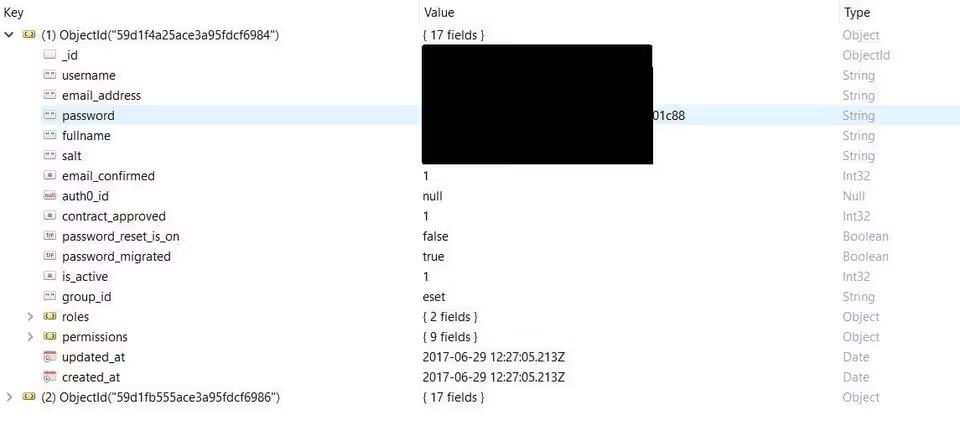
The personal data was limited compared with identity-document leaks like the MisterTemp exposure in France. The license material was the bigger risk. Valid keys and license passwords can be resold or used to activate pirated copies. The database was also writable, so an attacker could have changed records or wiped them and left a ransom note, which is what happened to thousands of other MongoDB instances at the time.
Timeline: From Discovery to Shutdown
- December 12, 2018—Bob Diachenko finds the exposed instance through Shodan, and HackenProof sends a security alert to ESET's security team the same day.
- December 17, 2018—The instance is taken offline, and ESET acknowledges the incident.
- December 27, 2018—HackenProof publishes its report.
Five days from report to shutdown is fast by the standards of these disclosures. The FIESP database in Brazil came down only after a journalist escalated the report publicly, and MisterTemp took nearly three weeks and a phone call to management. ESET had a security team that received the alert and acted on it. That's the difference a working disclosure channel makes.
ESET's Response
ESET confirmed the incident and credited the researcher publicly. Its security team sent HackenProof the following statement:
ESET's Security team would like to thank Bob Diachenko for responsibly reporting the vulnerability to us. This information has helped us to improve the security of our online services while preventing malicious exploitation of this vulnerability.
— ESET Security Team, December 2018
The database was secured before any destructive attack was detected, so customer records stayed intact. ESET didn't publish details on whether affected license holders were notified or whether exposed keys were reissued. In 2018, South African law didn't require either.
Would This Trigger a POPIA Fine Today?
Probably not a fine on its own, but it would trigger mandatory notification, and ignoring that is what gets organizations fined. South Africa's Protection of Personal Information Act (POPIA, Act 4 of 2013) was on the books in 2018, but most of it wasn't in force yet. It took full effect on July 1, 2020, and became enforceable on July 1, 2021, after a one-year grace period.
Two sections would apply to an exposure like this one today:
- Section 19 requires reasonable technical and organizational measures to protect personal information. A database open to the internet with no authentication is hard to defend under it.
- Section 22 requires notifying the Information Regulator and affected people when there are reasonable grounds to believe personal information was accessed by an unauthorized person. A writable database indexed by Shodan meets that bar, even without proof of misuse.
The Regulator's fines so far have followed failures to act, not the breaches themselves. Its first fine, in July 2023, was ZAR 5 million against the Department of Justice, which had failed to renew its SIEM and antivirus licences since 2020 and then ignored an enforcement notice. The maximum is ZAR 10 million. More recent fines are smaller and target the same pattern: Central Johannesburg TVET College was fined R500 000 in 2026 for not complying with an enforcement notice after a breach it hadn't reported. A distributor exposing customer license data today would be expected to notify first and fix fast.
Is Exposed MongoDB Still a Problem in 2026?
Yes, and an exposed instance is now almost always already compromised. A five-year Ransomnews study tracked exposed databases from May 2021 to May 2026. Of 3,532 MongoDB instances found open on a default port, 3,525 already carried a ransom note. The same automated extortion that started hitting open MongoDB databases in late 2016 is still running, and it finds new targets within hours.
A second risk arrived in December 2025. MongoBleed (CVE-2025-14847) lets an unauthenticated attacker read leaked server memory from unpatched MongoDB, which can include credentials and tokens. It affects versions from 3.6 through 8.2.2, and Shadowserver counted more than 87,000 internet-accessible instances days after disclosure, most still unpatched. CISA added it to its Known Exploited Vulnerabilities catalog. So even a password-protected MongoDB server facing the internet could leak data if it wasn't patched.
The pattern isn't limited to MongoDB. Elasticsearch has followed the same path since 2018, as our year-by-year history of Elasticsearch data breaches shows.
ESET's Distributor Network Was Hit Again in 2024
Six years later, a different ESET distributor was breached in a far more dangerous way. On October 8, 2024, attackers who had compromised Comsecure, ESET's exclusive partner in Israel, sent phishing emails from the legitimate eset.co.il domain. The emails posed as ESET's "Advanced Threat Defense Team" and linked to a ZIP file hosted on an ESET Israel subdomain. Inside was a data wiper disguised as security software.
ESET said its own systems weren't compromised and that the limited campaign was blocked within ten minutes. But the targets didn't see a distributor. They saw ESET's name, logo, and domain.
The two incidents are very different: a misconfigured database in 2018, a targeted attack in 2024. They share the same structural lesson. When a local partner operates your brand, its infrastructure is part of your attack surface. A weakness there exposes your customers, and the headline uses your name.
How to Secure MongoDB Deployments
The misconfiguration behind this incident is still entirely preventable:
- Turn on access control before a MongoDB instance goes live, with a separate least-privilege user for each application.
- Keep
bindIplimited to localhost or private interfaces, and never expose port 27017 to the internet; put the database behind a VPC, VPN, or allow-listed firewall rules. - Enable TLS for client and replica set connections.
- Patch self-managed servers against MongoBleed (fixed in 8.2.3, 8.0.17, 7.0.28, 6.0.27, 5.0.32, and 4.4.30), then rotate database passwords and API keys, since they may have leaked from memory.
- Scan your own IP ranges with Shodan, Censys, or Binaryedge, so you find an exposed instance before a ransomware bot does.
- Hold distributors and resellers who run your brand to the same standard, and include their domains and infrastructure in the scope of your bug bounty program and security reviews.
- Keep a security contact that answers. ESET's quick fix came from a team that received the alert and acted on it within days.
Frequently Asked Questions
What data was exposed in the ESET South Africa breach?
A 50GB MongoDB database exposed license purchase orders with owners' names and emails, license keys and passwords, more than 12,000 license files, email filtering lists, customer support feedback, and two administrator logins with hashed and salted passwords.
Was ESET itself breached?
No. The database belonged to ESET Southern Africa, which was operated by an independent distributor, 4D Innovations Group, rather than by ESET's headquarters.
How long did it take to secure the database?
Five days. HackenProof reported it on December 12, 2018, and the instance was taken offline on December 17, 2018.
Would this breach be reportable under POPIA today?
Very likely. Section 22 of POPIA requires notifying the Information Regulator and affected people when personal information may have been accessed without authorization. An open, writable database indexed by a public search engine meets that test.
Has ESET had any similar incidents since?
Yes. In October 2024, attackers breached Comsecure, ESET's distributor in Israel, and used its email servers to send wiper malware disguised as ESET software. ESET said its own systems weren't affected.
More topics: