'%3e%3cpath%20d='M12.4997%201.33325C10.39%201.33325%208.32772%201.95884%206.5736%203.13091C4.81947%204.30298%203.4523%205.96888%202.64496%207.91796C1.83763%209.86704%201.62639%2012.0118%202.03797%2014.0809C2.44955%2016.15%203.46545%2018.0506%204.95721%2019.5424C6.44897%2021.0342%208.34959%2022.0501%2010.4187%2022.4616C12.4878%2022.8732%2014.6326%2022.662%2016.5816%2021.8546C18.5307%2021.0473%2020.1966%2019.6801%2021.3687%2017.926C22.5408%2016.1719%2023.1663%2014.1096%2023.1663%2011.9999C23.1663%209.17094%2022.0425%206.45783%2020.0422%204.45745C18.0418%202.45706%2015.3287%201.33325%2012.4997%201.33325ZM12.4997%2021.3333C10.6537%2021.3333%208.84922%2020.7859%207.31436%2019.7603C5.7795%2018.7347%204.58322%2017.2771%203.8768%2015.5716C3.17039%2013.8662%202.98555%2011.9896%203.34568%2010.1791C3.70581%208.36859%204.59473%206.70554%205.90002%205.40025C7.20531%204.09496%208.86835%203.20605%2010.6788%202.84592C12.4893%202.48579%2014.3659%202.67063%2016.0714%203.37704C17.7768%204.08346%2019.2345%205.27974%2020.2601%206.8146C21.2856%208.34945%2021.833%2010.154%2021.833%2011.9999C21.833%2014.4753%2020.8497%2016.8492%2019.0993%2018.5996C17.349%2020.3499%2014.975%2021.3333%2012.4997%2021.3333Z'%20fill='white'/%3e%3cpath%20d='M19.167%208.06667C19.042%207.9425%2018.8731%207.8728%2018.697%207.8728C18.5208%207.8728%2018.3519%207.9425%2018.227%208.06667L10.8269%2015.4333L6.82695%2011.4333C6.70495%2011.3016%206.53562%2011.2237%206.35621%2011.2169C6.1768%2011.21%206.00201%2011.2747%205.87028%2011.3967C5.73856%2011.5187%205.66069%2011.688%205.65382%2011.8674C5.64694%2012.0468%205.71162%2012.2216%205.83362%2012.3533L10.8269%2017.3333L19.167%209.01333C19.2294%208.95136%2019.279%208.87762%2019.3129%208.79638C19.3467%208.71514%2019.3642%208.62801%2019.3642%208.54C19.3642%208.45199%2019.3467%208.36485%2019.3129%208.28361C19.279%208.20237%2019.2294%208.12864%2019.167%208.06667Z'%20fill='white'/%3e%3c/g%3e%3cdefs%3e%3cclipPath%20id='clip0_2790_31187'%3e%3crect%20width='24'%20height='24'%20fill='white'%20transform='translate(0.5)'/%3e%3c/clipPath%3e%3c/defs%3e%3c/svg%3e)



Introduction
The cryptocurrency market has entered a new era of global crypto regulations. With a projected growth from $3.8 trillion in 2024 to $8–10 trillion by 2026, digital assets are no longer a niche sector but a critical part of the global financial system.
The regulatory shift is also a direct response to security challenges. Since 2016, over $15.3 billion has been stolen in Web3 hacks, highlighting systemic vulnerabilities across exchanges, custodians, and DeFi protocols. Traditional approaches such as one-off security audits are no longer sufficient. Regulators now demand continuous security evidence — proof that organizations can demonstrate resilience not just once, but on an ongoing basis.
Against this backdrop, jurisdictions worldwide are accelerating the rollout of comprehensive frameworks for crypto service providers. These frameworks are not merely compliance checklists; they are becoming prerequisites for market trust, user protection, and sustainable growth.
Global Regulatory Landscape
Cryptocurrency regulation remains uneven worldwide. Each jurisdiction adopts its own approach based on market maturity, local risks, and political priorities. This creates a fragmented environment where rules can vary significantly from one country to another.
United States
The U.S. lacks a single comprehensive crypto law. Agencies enforce overlapping rules: the SEC classifies many tokens as securities, the CFTC regulates derivatives, and FinCEN oversees AML/KYC compliance. While ETFs for major assets like BTC and ETH are live, regulatory uncertainty regarding the status of other tokens (such as XRP and DOGE) persists, and the resolution of legal cases will likely continue through 2025.
European Union
The EU implements structured frameworks, including MiCA and DORA. MiCA defines crypto-asset service providers (CASPs) and their authorization requirements, while DORA sets standards for operational resilience and cybersecurity. As of December 2024, MiCA is fully effective, with transitional periods extending to July 2026 for existing providers.
Asia
Regulations differ widely:
- Japan streamlines custody and stablecoin rules while ensuring user protection.
- Hong Kong introduced ETFs in April 2024 and enforced VATP compliance.
- Singapore promotes innovation under MAS supervision, combining licensing with strict AML controls.
- China maintains bans on crypto transactions but advances its CBDC initiatives.
United Arab Emirates
The UAE is formalizing crypto regulations via VARA (Dubai) and ADGM (Abu Dhabi). VARA imposes leverage caps and stricter marketing rules, while ADGM introduces cybersecurity obligations for exchanges starting July 2025.
Why the Crypto Industry Needs Regulation
- Stricter Compliance Demands
Regulators now require continuous adherence to standards, including regular smart contract audits.
- Rapid Market Scaling
Crypto markets are expanding quickly, particularly in the EU, Asia, and the Middle East.
- Response to Hacks and Scams
Significant security incidents have prompted regulators to establish clear rules to protect investors and market integrity.
Regulations and Frameworks Security Mapping
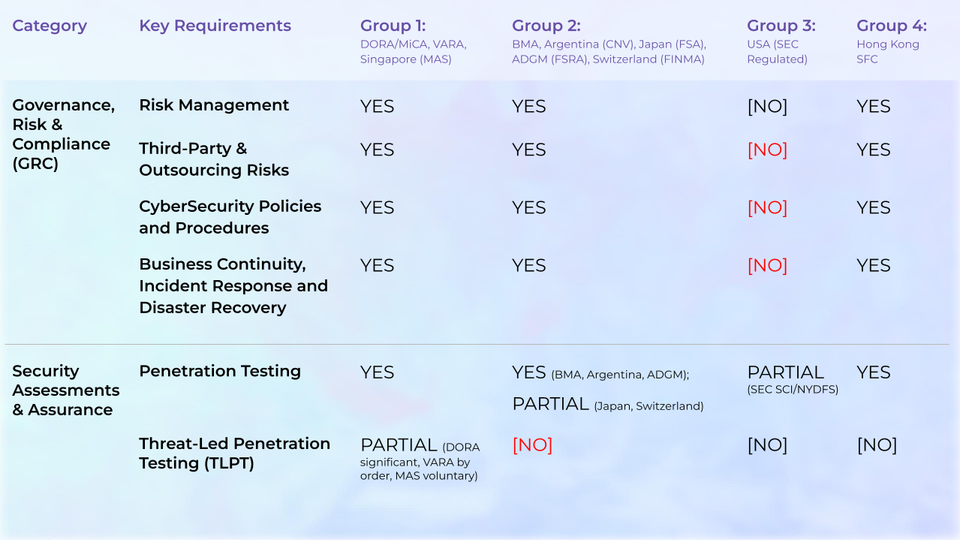
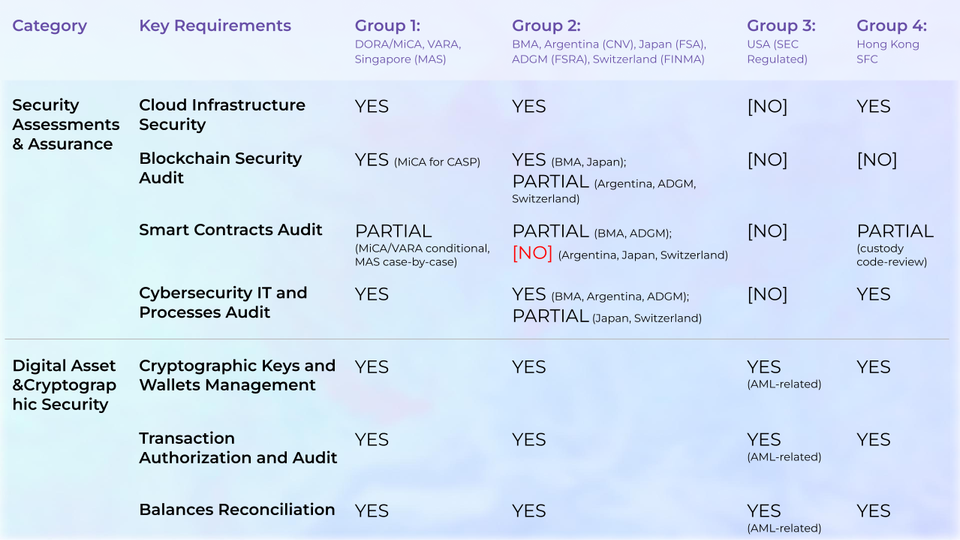
The following section provides a concise overview of global regulatory requirements. As shown in the table below, it is easy to see which categories of obligations – such as cybersecurity, operational resilience, and governance – apply to each regulatory group, allowing businesses to quickly identify the frameworks relevant to their operations.
Upcoming Regulatory Milestones
- EU MiCA – Full effect: December 30, 2024; transitional grace period until July 1, 2026.
- EU DORA – In force: January 17, 2025; first mandatory TLPT by January 17, 2026.
- Dubai VARA – New marketing rules active: October 1, 2024; enforcement ramping through 2025.
- Hong Kong SFC – Full VATP compliance since June 1, 2024.
- Japan FSA – New custody and stablecoin rules: April 2025.
- USA NYDFS – Stricter cybersecurity reporting from October 15, 2025; federal stablecoin law phases start in 2026.
Turning Regulation Into Competitive Advantage
Regulatory compliance can be leveraged as a strategic asset rather than just an operational requirement. Businesses that align processes and security practices with emerging rules can accelerate market trust, expand partnerships, and improve user confidence. Key strategies include:
- Compliance-by-design – Map all services and operations to applicable regulatory perimeters (MiCA CASP types, VARA permissions, ADGM categories) to ensure proactive readiness.
- Continuous Security – Implement bug bounty programs, crowdsourced audits, patch SLAs, and clear disclosure policies to meet ongoing cybersecurity expectations.
- Evidence & Reporting – Maintain comprehensive KPIs (e.g., MTTR, valid‑to‑invalid ratio), attestations, policy audits, and vendor governance documentation to demonstrate compliance and operational resilience.
- Localization – Adapt marketing, promotional, and disclosure practices to local rules (for example, UK promotions regulations) to support cross-border compliance.
Conclusion
Crypto regulations are not a verdict – they are security challenge that can be managed. Bug Bounty programs and Dual Defense Audits are practical ways to ensure your product is safe and fully verified. If you’re considering these solutions or still deciding what fits your project best, schedule a call with our team – we’ll answer your questions and help you navigate the evolving regulatory landscape with confidence.